
It’s the first day of filming, and the crew is shooting a short scene in the boys’ bathroom at Bainbridge Island’s Woodward Middle School. Title character Chaz, played by Bryson Robinson of Brat TV fame, is combing his hair and admiring himself in the mirror.
“Keep your hand above your head. That’s really good for our angle,” director Andrew Taylor instructs. Then he calls, “Action!” Robinson repeats the movement, this time more slowly. “We got it!” Taylor announces. He, Robinson, and Anisa Ashabi (’20 Comm.) watch the playback on a monitor in the hallway, all smiles.
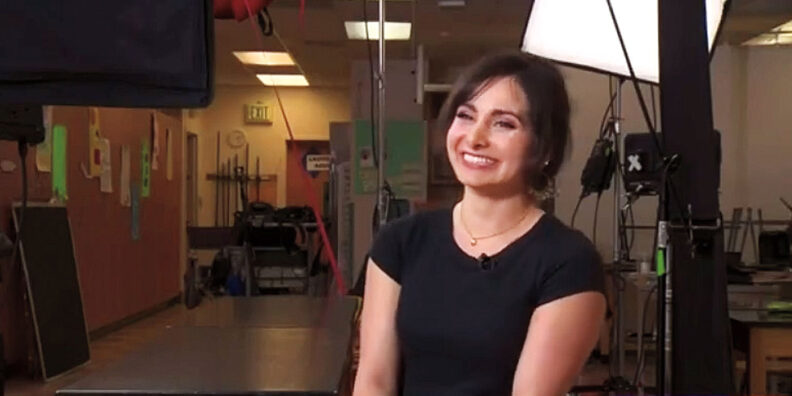
“It’s definitely surreal to get to film where I first envisioned it,” says Ashabi, author of the 2022 young adult novel Finding Chaz. She recently adapted the story for television, writing the 41-page screenplay for the pilot. She serves as executive producer.
Filming took place during nine days in July at the middle school Ashabi once attended. While writing the book, “I was visualizing these exact rooms and these exact hallways,” she says.
Finding Chaz follows a young Iranian American girl as she navigates high school in a homogenous and fictional small town in eastern Washington. Roxie Nazari, portrayed by Emily David, deals with persistent bullying by Chaz, a male classmate notorious for harassing girls at school.
“They’re 15. It’s their first year of high school. They’re in the middle of all the awkward terrible feelings,” Ashabi explains. Plus, “Chaz is struggling. He has no idea how to be. He’s essentially wearing a mask.”
Roxie learns the truth when she and Chaz find themselves in in-school suspension, and an unlikely friendship develops. The pilot covers just the first few chapters of the coming- of-age story, set in the middle of the first decade of the 2000s.
“I think the strongest part of the script is the dialogue,” Ashabi says. “It’s snappy. It’s punchy. It’s dramedy. But it also has themes and elements that transcend generations. I think it hits everything audiences are yearning for.”
Filming took place on Bainbridge Island and in north Kitsap County, where Ashabi—Iranian American like her protagonist—grew up, and where, she says, “I never saw anyone of my own heritage.”
Ashabi was just 13 when she started writing the book with the encouragement of her mother, who challenged her “to do a fun narrative project. A lot of it was so raw because I was talking about my own feelings and my own experiences as I was going through them in real time.”
She revisited the manuscript during the COVID-19 pandemic after graduation from WSU. It took more than two years to edit, rewrite, and trim the original draft. “It was,” Ashabi says, “a labor of love.”
Ashabi opted for a small press because, she says, “I always knew I wanted to adapt it for the screen, and I wanted to retain full creative control and all of the rights.”
Through “a distant family connection,” she met producer and writer William Schmidt, who worked on Knight Rider and Falcon Crest, among other shows. He encouraged her, gave her advice, and introduced her to his agent.
Ashabi has raised the majority of the funds needed to produce the pilot, sponsored by the Northwest Film Forum.
She’s keeping costs low—using donated locations as much as possible for filming, for example.
Most of the extras are high school and college kids from the community. Some crew members, like prop master Savanna Rovelstad, a member of Bainbridge Island’s Race Equity Advisory Committee, started out as volunteers.
“I read the book in three days and stayed up until 3 a.m. one night to finish it. Reading a story like the one Anisa wrote, to me, meant that maybe I wasn’t as alone. As a queer BIPOC woman, seeing the representation of gay characters and mixed characters—it was very important and meaningful,” says Rovelstad, who grew up on Bainbridge Island often feeling “like an outsider. Reading her book made me feel like maybe somebody saw us outsiders and cared.”
Ashabi has been meeting with potential donors and consulting on postproduction work. “It’s very exciting,” she says. “I probably have like 800 reminders on my phone. Siri is the glue holding me together.”
The pilot could be completed within six to 12 months from the end of filming. Then the plan is to pitch it to streaming services.
So stay tuned.
Watch more
Video: Former KING 5 intern chases TV dreams on Bainbridge Island