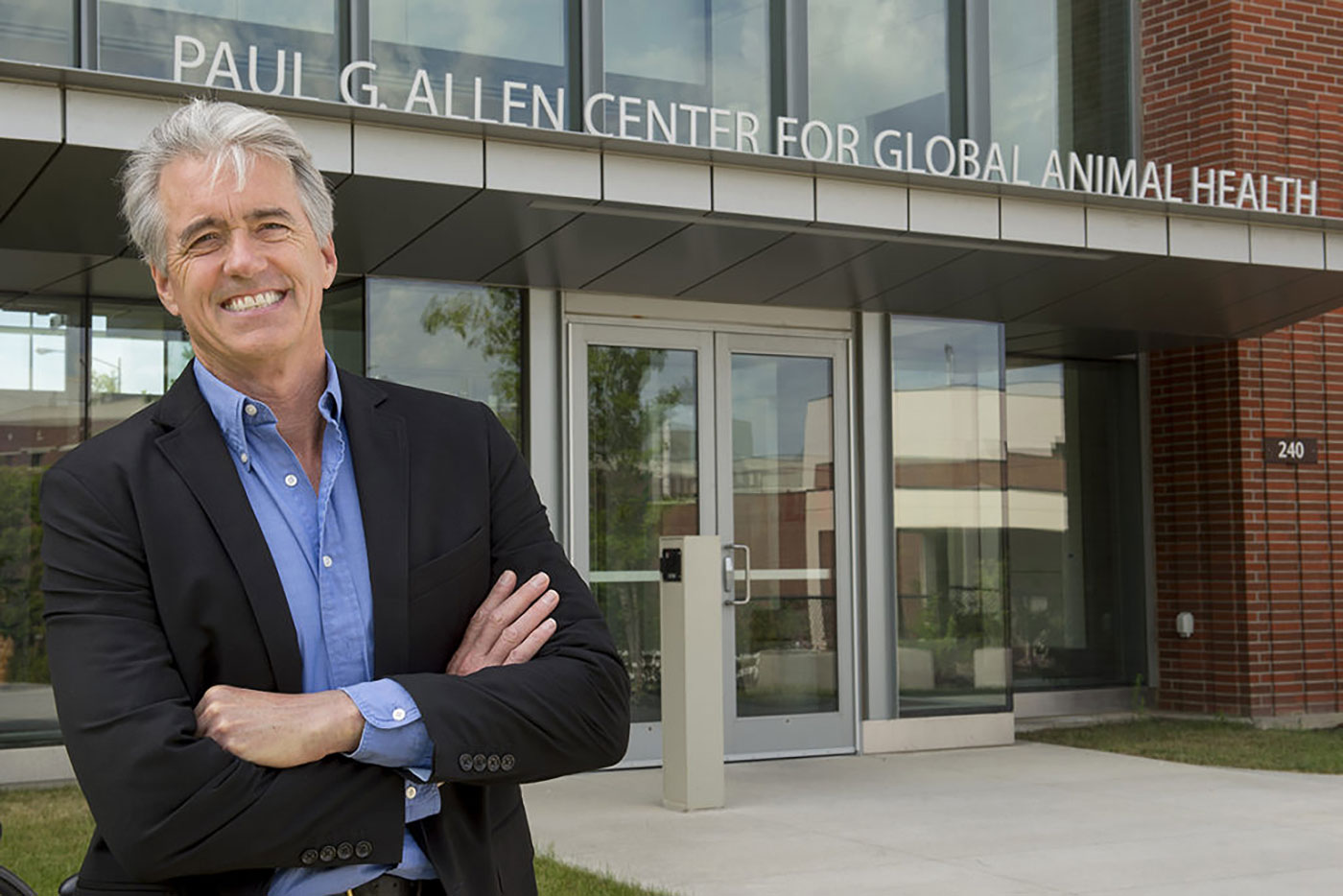
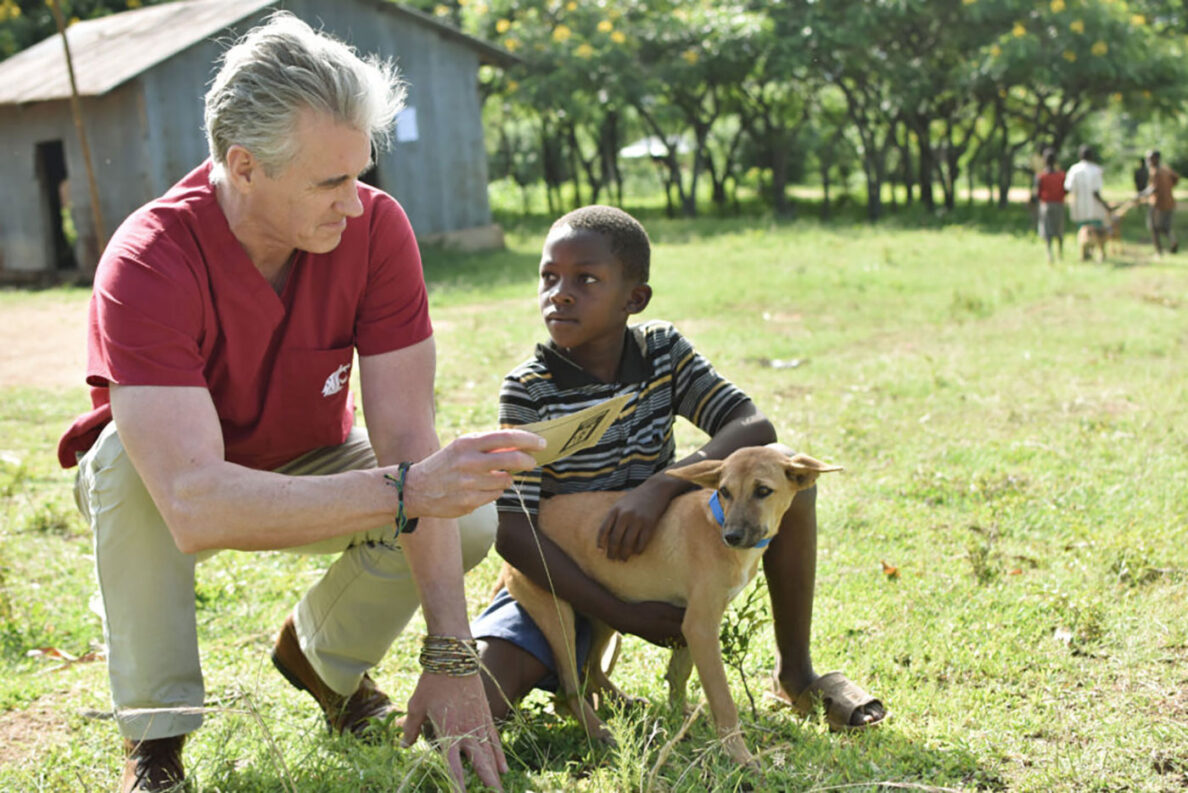
Guy Palmer is a world-renowned researcher, health advocate, leader, and alum of Washington State University. Here, his friend and colleague Terry McElwain and former student and current colleague Michelle Shoemaker write about Palmer’s influence and friendship.
Read more about Palmer’s life and work.
In Praise of Guy Palmer
By Terry McElwain (’86 PhD Vet Sci.)
Terry McElwain met Guy Palmer in 1974 when they were both undergraduates at Kansas State University. McElwain followed him in 1981 to Washington State University, where they worked together until McElwain retired in 2016. Here, McElwain writes about what makes his longtime friend and colleague stand out.
I first met Guy in 1974 when we were undergrads together at Kansas State University, both intent on being admitted to the College of Veterinary Medicine to pursue our dreams of becoming veterinarians. We were admitted to veterinary school in the same class and were lab partners throughout our professional education there. Guy went on immediately to graduate school at Washington State. I joined him there in 1981, and we worked learned and worked together for nearly 50 years until I retired in 2016. I give you this background because I think it is not all that common to find two colleagues in academia with that kind of history together. He is like a brother to me.
It takes drive, intellect, insight, vision, risk taking and charisma to develop successful programs in academia, particularly at a level beyond the individual successful faculty member. But it is rare to find all those characteristics in one individual. Guy has them all and used them all to develop programs not only in his own research field but also at the College and University level. His dedication to WSU can be appreciated best in knowing that countless recruiting attempts at many prestigious academic institutions and non-profits were ultimately unsuccessful. He is a Coug through and through.
Guy is a consummate scientist in the truest sense. He is open-minded, meticulous in his work, sets the highest standards, is a revered mentor, and has a cadre of scientists he trained as a legacy in his field. He is a writer’s writer and has helped not only his students but also his colleagues, including me, to develop their own manuscripts and grant proposals that ultimately were successful endeavors due to his editing contributions to their work.
We made so many memories together through these 50 years that there is no one thing that I think of when I think of him. It is him dressed as the Easter Bunny to entertain our kids when they were young. It is him on the river in his kayak negotiating rapids, or him in the tent laughing at my son who wanted nothing more than a warm dinner as the rain fell hard outside during a mountain storm. Or the long trips we made to Africa, him with a glass of red wine using his quiet time editing a manuscript for a student. Countless personal meetings, throwing ideas back and forth, debating different views. Celebrating the successes, moving on from the setbacks more determined than ever. And so many others.
His legacy at WSU is clear for all to see and will be celebrated well. So I don’t think there is anything I can add to that. WSU has given him a lot of opportunity for success. He would be the first to say that. But the institution has been paid handsomely for it. Through his dedication to WSU He has made a singular contribution that I hope will inspire others to follow.
Another thing I think is important to note is that Guy and I both were the beneficiaries of a very strong research foundation in infectious diseases and immunology that our mentor, Travis McGuire (’68 PhD Vet. Sci.)., was responsible for in large part. Travis was fortunate to be preceded by Jim Henson (’64 PhD Vet. Microbiol. & Pathology), his own mentor, who was equally important. Guy would be the first to acknowledge that foundation for his own success. And Guy is leaving his own legacy of strengthening and broadening that foundation to Global Health research. Those are the kind of gifts that should never be underestimated because they give the next generation such a solid footing to once again build into something new and better. Not many young academics received that gift.
Ode to Guy Palmer
By Michelle Shoemaker ’04 DVM
Michelle Shoemaker (’04 DVM), chief veterinary officer at Vetcor, met Guy Palmer as a veterinary student at Washington State University. Recently, she has traveled with him to Tanzania in support of Rabies Free Africa. Here, she reflects on his life and work.

It is both an honor and a privilege to celebrate Dr. Guy Palmer, whose extraordinary vision, leadership, and compassion have shaped not only the Washington State University College of Veterinary Medicine but also the world beyond it. As the founding director of the Paul G. Allen School for Global Health, Dr. Palmer has built a legacy that transcends borders, a legacy grounded in science, humanity, and hope.
Dr. Palmer’s work has forever changed the course of global animal and human health. Through Rabies Free Africa, he has inspired an international movement, one that is saving lives every day. His dedication to eliminating rabies has brought together veterinarians, scientists, students, and communities across continents, transforming tragedy into triumph and fear into hope. Because of his vision, children in rural villages can grow up safely, and the communities he has touched now live with the promise of a healthier future.
I was first honored to know Dr. Palmer as a veterinary student at Washington State University. Even then, his passion for global health and his belief in the power of science to serve humanity left a deep impression on me. Today, in my current role, I have the privilege of continuing to learn from him, and of seeing firsthand how his influence extends far beyond the university.
Over the past several years, I have had the tremendous honor of joining Dr. Palmer on three trips to Tanzania. Each time, I witnessed the profound reach of his life’s work. Watching him interact with the people whose lives have been changed by access to vaccination and education has been deeply moving. Those experiences opened a passion deep inside me, one that fuels my own desire to give back, to teach, and to serve. His example reminds all of us that the most lasting impact comes not from what we achieve individually, but from what we inspire in others.
Dr. Palmer’s influence cannot be measured simply by the programs he built or the awards he’s earned, but by the ripple effect of his mentorship and his humanity. He has shaped generations of veterinarians, scientists, and leaders who will carry forward his mission of One Health, protecting the interconnected well-being of people, animals, and the environment.
His legacy will continue to live on at Washington State University—in the classrooms where his words first inspired curiosity, in the laboratories where his vision continues to guide discovery, and in every community around the world where his work has saved lives.
Dr. Palmer has shown us what it means to lead with purpose, to care deeply, and to use knowledge to make the world better. His story is, and always will be, part of the soul of Washington State University, a legacy that will continue to shine brightly for generations to come.