
We were searching grocery stores and markets around Ho Chi Minh City, trying to find apples. Not just any apples but Cosmic Crisp® apples, bred at Washington State University.
After a long day of looking, we stumbled across an assortment of Cosmic Crisps at a grocery store within a mall more than 7,500 miles from WSU’s Tree Fruit Research and Extension Center—the birthplace of the Cosmic Crisp.
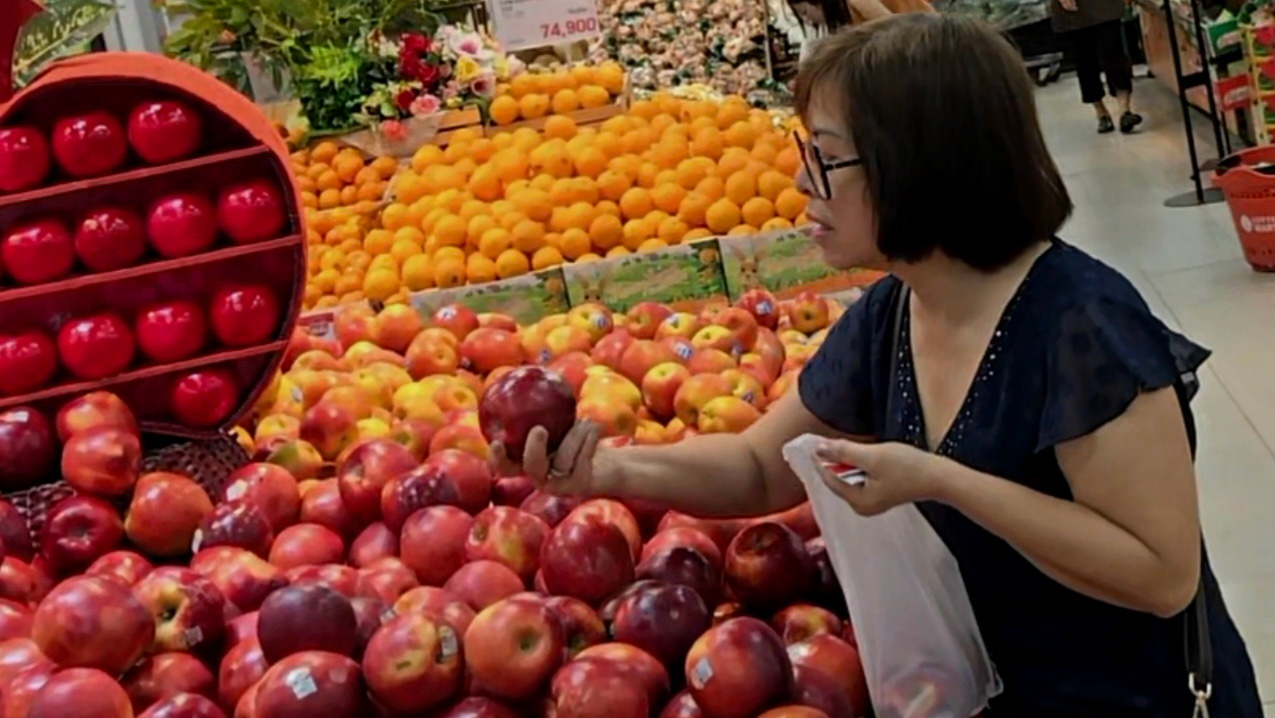
“To see something that we’d been anticipating so heavily for so long was really satisfying. I felt a huge sense of pride as a Coug,” says Andrew Perdue of Bonney Lake, a senior studying broadcast production at WSU.
He and I were among the four Edward R. Murrow College of Communication students chosen to visit Vietnam through the one-credit Backpack Journalism Program during spring break 2026. Our mission: report on imports of Cosmic Crisp apples. It was a once-in-a-lifetime opportunity, and I feel so grateful that I got to be a part of it.
Benjamin Shors, chair of the Department of Journalism and Media Production, and Alison Boggs, a Murrow College professor who leads the Backpack Journalism Program, chose Vietnam “because the number of Cosmic Crisp apples being exported to that country from Washington state has skyrocketed in the past few years,” Boggs says. “This has happened while export numbers for most other apples have remained somewhat flat or declined.”
Past programs have traveled to Kenya, Serbia, Armenia, Germany, Nepal, Argentina and elsewhere. But, Boggs says, the goal is always the same: to get out there and create groundbreaking stories.
In Vietnam, we wrote and created multimedia stories about apple exports, the popularity of apples within the region around Ho Chi Minh City, and what consumers look for when buying apples in Vietnam. Stories from the reporting trip have been published by the Daily Evergreen and have appeared on Murrow News 8 as well as social media.
Stories from other excursions have been published by news outlets in Pullman and Spokane as well as The Poynter Institute, a journalism think tank in Florida; CBS News online; the Standard in Kenya; and more.
“It’s career-changing having an international byline,” says Bruce Pinkleton, dean of Murrow College. “And then for the college, we go right along with that. One way to think about it is that you are our product so when you do well, we do well.”
Lawrence Pintak, founding dean of Murrow College, started the Backpack Journalism Program in 2011. It’s completely donor funded to give students international reporting experience. While not all students plan on becoming international reporters, Pintak says, “everyone needs to see the world, to understand there are other perspectives out there, to understand not everyone lives the way we do.”
Our ten-day excursion ran March 12 to 21. Throughout the experience, my roommate, Arlo Popa, then a senior multimedia and broadcast news major from Everett, was struck by people’s camaraderie. “I absolutely loved their sense of community—going out at night and seeing the city alive with families and friends all talking, chatting and being in the moment in these little chairs on every street.”
The first day, we went on a walking tour to get the lay of the land. At the Saigon Central Post Office, artisans were selling hand-made souvenirs, and I filmed a news package, capturing the market housed in the historical building. Across the street, a beautiful nineteenth-century church was undergoing restoration, and I created a video for social media. Restoration work began in 2017 on Notre Dame Cathedral and is expected to continue into 2027.
We also visited the War Remnants Museum, which featured raw imagery of the war in Vietnam. Even though it was difficult to see, it ended up being my favorite part of the trip because it was such an eye-opening experience.
The bulk of our time was spent learning about Cosmic Crisps and the food industry. One day, we visited a port, where produce gets delivered in crates to be shipped throughout the region. We took an immersive virtual tour of the docks using a VR headset. The simulation offered a first-person point-of-view, allowing us to experience an employee’s perspective of what it’s like to work there.
“I wish we could’ve seen it in person but, for being virtual, it was pretty detailed,” says Grace Harvey (’26 Comm.) of Vancouver. She covered the economic impact of Cosmic Crisps, including royalties for WSU, among other stories.
We also got to visit a packing facility, where we met industry leaders and learned about their marketing strategies. We watched a slideshow emphasizing the fact that the more fun a product looks, the more enticing it is for consumers to purchase, and I created another video package about how packing fruit in Vietnam differs from the US.
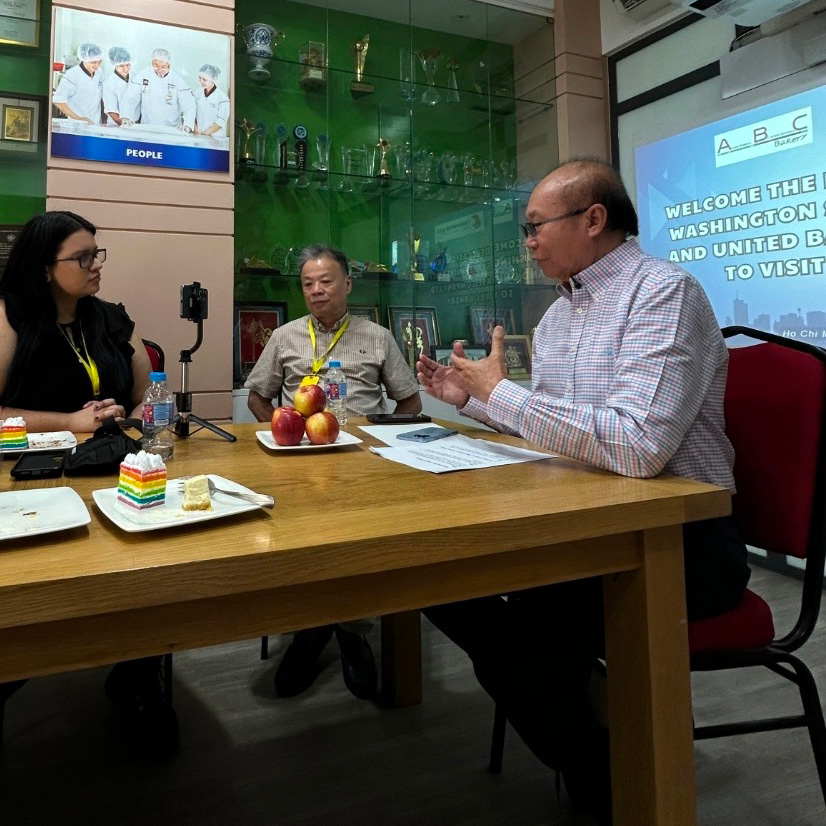
I particularly enjoyed meeting Chef Kao Sieu Luc, founder and CEO of the ABC Bakery chain. He’s known as Vietnam’s “Bread King,” and I had been looking forward to interviewing him. During the COVID-19 pandemic in early 2020, Luc created a vibrant pink bread using dragon fruit puree instead of water, helping save farmers from severe losses and inspiring a culinary trend.
I was pleased to learn Luc considers his family his top accomplishment. In fact, ABC Bakery is named after the first letter of each of his children’s names: Angela, Bruce, and Christine.
ABC Bakery has more than 40 collaborators, including McDonald’s. We got to see buns being made for local McDonald’s stores. I found it so fascinating how strict food regulations are in Vietnam and used that idea as the basis for another video package.
All four of us had the honor to speak at The American Center about Cosmic Crisps. I talked about the growing process. Weeks prior, Popa and I visited Orchard Barracuda in Othello, where we learned how Cosmic Crisps are grown. The audience was very engaged.
“Our students had been researching the export market for Washington apples for two months and were hit with some hard questions about the differences in apple varieties,” Boggs says. “They handled the questions with poise, professionalism, and good humor, even though I know they were nervous.”
One of the things that struck all of us was the warmth of the people. “I had been told about how warm and welcoming Vietnamese people are, and I found this to be extremely true, everywhere we went,” Boggs says. “Once again, I discovered—and I think my students did, too—that we are all human … and the commonalities we share are so much greater than the differences. … The hospitality and kindness are what I will remember most about the Vietnamese people.”
Olivia Soliz is a senior from San Jose, California, who aims to work in broadcast journalism.
More about Murrow College
The Legacy Stays Alive (50 years of The Murrow Symposium)