
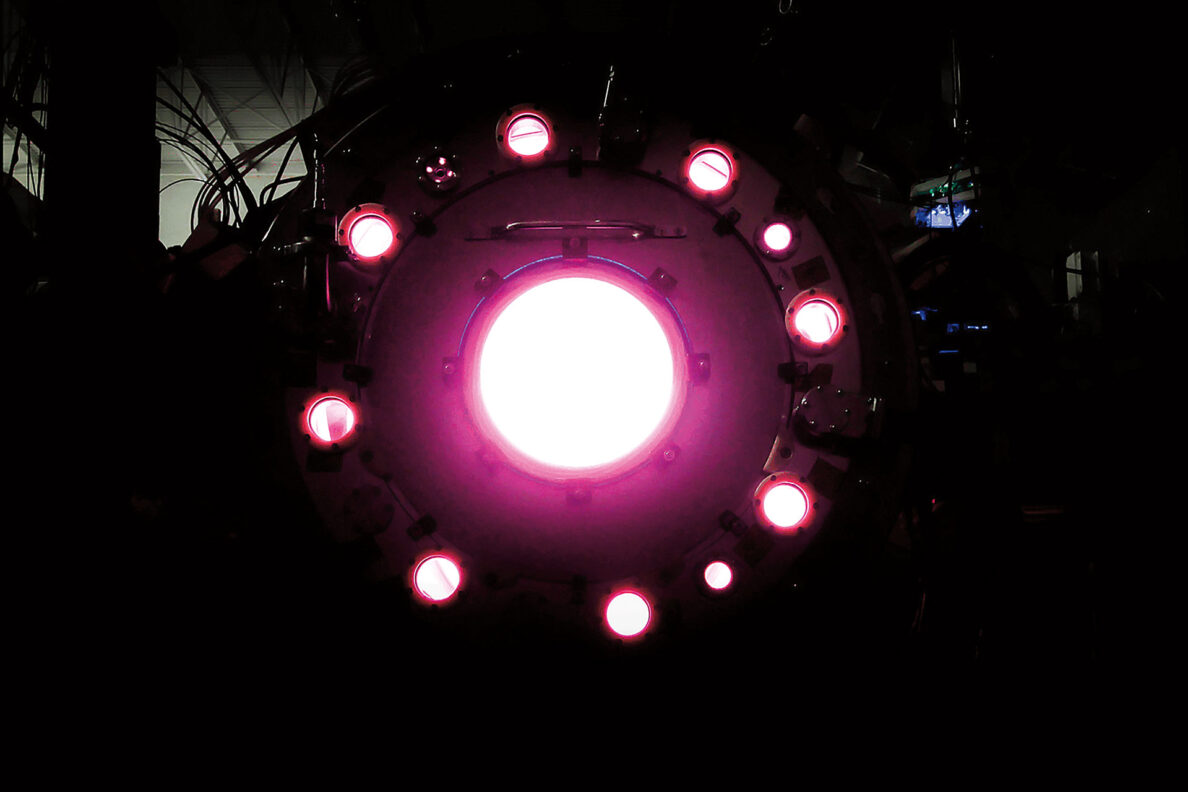
For nearly a century, scientists have chased the idea of nuclear fusion for domestic power. The cataclysmic fusion of atoms that powers our sun and other stars holds the promise of clean, abundant energy without long-lived radioactive waste.
While that reality isn’t here yet, the Seattle area is becoming a hub for fusion startups. Helion Energy and Zap Energy in Everett, and Avalanche in Seattle are each developing technologies for fusion power plants, with the goal of generating electricity for the grid. Cougs are helping build the industry as part of the workforce.
Nuclear fusion is sometimes called the 21st century’s grand engineering challenge. Scientists and engineers are working to recreate the sun’s processes in a controlled environment with magnetic fields and plasma temperatures of 100 million degrees Celsius.
Vince Giacalone (’11 Mech. Eng.) is a production manager at Helion Energy. He oversees a team that works with engineers to develop and build hardware for fusion generators and small-scale plasma testbeds. It’s an exciting, fast-paced work environment.
“There’s an incredible vibe and energy on the team,” Giacalone says. “It’s like a design project from back in school where everybody’s having fun, but the stakes are real. There’s a huge net win for the world to have clean, low-cost, and abundant energy.”

Helion, founded in 2013, has a growing presence in Washington, with 600 employes, a fusion plant under construction near Wenatchee, and Microsoft lined up as a customer. Giacalone joined the company in 2024 after working as a general manager for a manufacturing firm.
“Helion is a five-minute drive from my previous workplace, but I hadn’t known there was a fusion startup down the road,” he says.
Other Cougar alumni at Helion include Zahra Armanfard (’23 PhD Phys.) and Shahriar Safaee (’21 PhD Mech. Eng.). Armanfard is an experimental scientist who studies plasma. Safaee designs electromechanical pulsed power systems used in Helion’s capacitor bank.
“The capacitor bank delivers the energy to the electromagnets that drive the fusion process, then recovers the energy produced during fusion,” he explains.
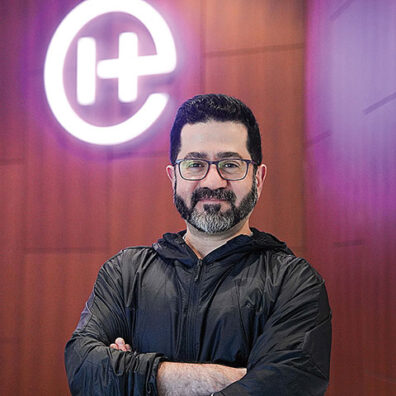
(Courtesy Helion Energy)
Fusion is different than the atom-splitting nuclear fission, which currently powers the world’s nuclear plants. In simplistic terms, fusion occurs when two light nuclei (usually hydrogen isotopes deuterium and tritium) fuse together, releasing energy. In the sun, fusion requires superheated plasma and immense pressure.
More than 40 fusion startup companies exist worldwide, all aiming for breakthroughs that will make fusion a viable power source. Billions of investment dollars are pouring into the industry. A 2022 accomplishment at Lawrence Livermore National Laboratory’s National Ignition Facility in California helped fuel the excitement. For the first time, the facility created a net gain of energy through nuclear fusion, with the output exceeding the energy used to create the reaction.
Helion has announced plans is to provide Microsoft data centers with fusion energy by late 2028, and to its second customer, steel manufacturer Nucor Corp., in 2030. But projections vary on when energy from fusion will become widely available. The World Economic Forum recently reported estimates ranging from the mid-2030s to the 2050s.
Society urgently needs clean, abundant energy, says Jay Nawash (’07 PhD Mat. Sci. & Eng.), Zap Energy’s research laboratory manager. Global demand for electricity is projected to triple by 2050, driven in part by the high energy needs of data centers and artificial intelligence. Climate change, meanwhile, has raised the stakes for generating electricity without burning fossil fuels.
“Fusion checks all the boxes as the most desirable energy source,” Nawash says. “There are no carbon emissions, the fuels are abundant and inexpensive, and public acceptance is high.”

Representatives from Helion, Zap Energy, and Avalanche gave presentations at Washington State University this year. The invitations came from John McCloy, professor and director of the School of Mechanical and Materials Engineering, who sees opportunities to expose students to nuclear fusion careers, and for WSU to partner with companies on research.
“Our students are excited about this. There’s a lot of promise for fusion in terms of its potential for clean energy,” McCloy says. The influx of private investment helps validate the industry’s progress, he adds.
“It indicates that nuclear fusion is not just a push from government and academia,” McCloy says. “There’s a commercial need, and investors believe it could be financially viable.”
Neither Armanfard nor Safaee expected to work in the fusion industry. For Armanfard, the hook was her doctoral work in spectroscopy, which she now uses at Helion to study temperature and impurities in plasma as part of the company’s experimental science team.
When Armanfard was evaluating job offers, she was drawn to the fusion energy mission. “I wanted to be part of something very good and very big that will change the world.”
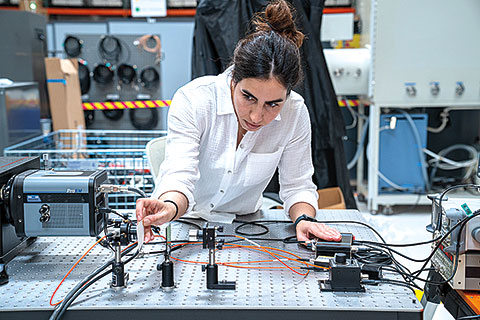
(Courtesy Helion Energy)
Before Safaee joined Helion, he worked at a large tech company developing virtual reality products. “They were cool products, but I realized that not many people would be able to afford them, and the impact wouldn’t be as widespread as I hoped,” he says.
Working toward a clean energy future gives him a greater sense of purpose, says Safaee, who encourages students to keep an open mind on where their degrees might take them.
“The WSU doctoral program taught me how to find solutions to hard engineering problems,” he says. “Every day, I go to work knowing that I’m designing and building hardware that can contribute to a better society.”