
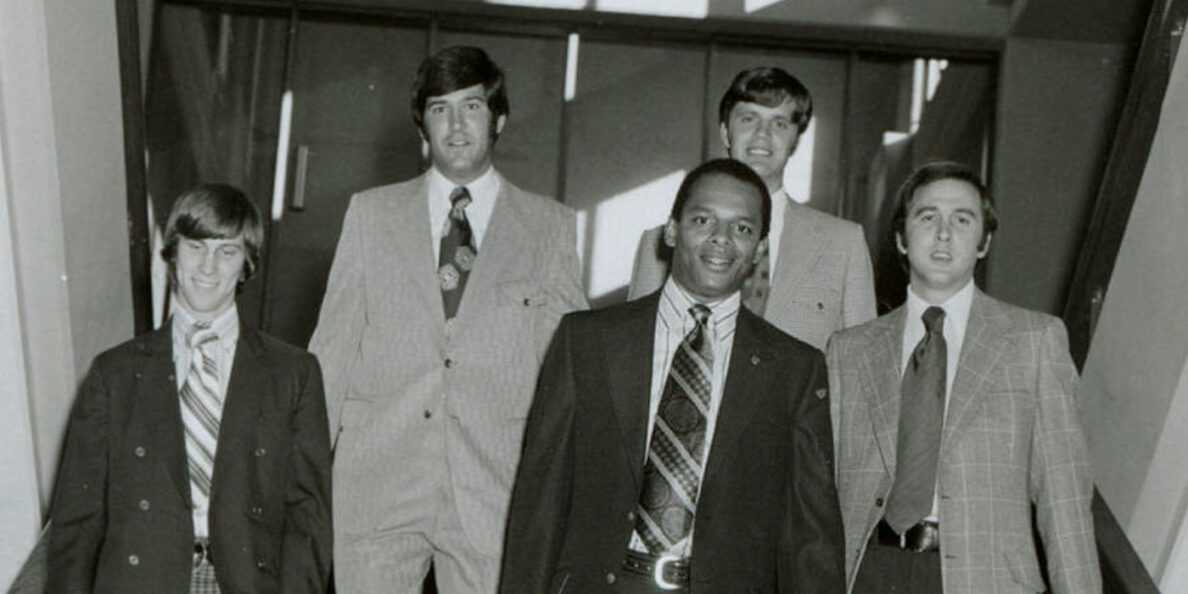
Legendary Washington State University basketball coach George Raveling died September 1, 2025, at 88. Here, alumni, friends, and fans share their favorite memories of the beloved coach.
In the athletic office
Summer and fall of 1974, I worked in the athletic office at WSU. I look back on it with the fondest memories. Here I was, a June ’74 grad, getting to work for Raveling, (Jim) Sweeney, and (Chuck “Bobo”) Brayton. Wow. I felt privileged. They were all great to work for/with, but Coach Raveling stood out to me because he made a point of acknowledging everyone in the office (and) was genuine and professional in all respects.
Stephanie Bariault (’74 Elem. Ed.)
Building a legacy
They were the best coaches. We, as a university, were so lucky to have them. Walking through campus as a student they all would say hello to everyone. It was a great time to be a Coug. And I truly believe they built the “Being a Coug” legacy.
So many memories, but one in particular. Hopefully, I remember correctly. Game in the 1973-1977 era. Basketball team playing not well. Referees were horrible. Crowd fed up. Started throwing ice cubes. Announcer says to stop. Referees threaten to penalize team for crowd behavior. Coach gets up, grabs microphone. Gym is silent. He says, “We’re gonna win with class, and we’re gonna lose with class.” All ice cube-throwing stopped. We Cougs respected him so much. This is one hard loss.
Kathy Scott (’75, ’76 MA Speech & Hearing Sci.)
Two dates with a dash
There will be an abundance of positive press about the passing of George Raveling. And for good reason because he was a singular pioneer in the world of sports and business.
Everything about George and his achievements is damn near remarkable—born in a segregated hospital in Washington, D.C., losing both his parents before he was a teenager, setting rebounding records at Villanova University (I saw him play Temple at the famous Penn Palestra back then), bodyguard for Martin Luther King, Jr. at the I Have a Dream speech in 1963 (he owned the copy of the speech), the first Black coach in the ACC when Lefty Driesell hired him as an assistant at Maryland in 1969, the first Black coach in the Pac-12 (then the Pac-8) when he was hired as head coach at WSU, ultimately landing at Nike in 1994 where he helped sign Michael Jordan and launch the iconic “Air Jordan” marketing campaign.
And much more!
But what might not be shared is just what an accessible and compassionate human he was. I know that first-hand because we had a close encounter not long after both of us had arrived in Pullman in 1972. I was less than a year home from Vietnam, trying to get my bearings and pursue a grad degree at WSU while George was mired in a last place finish in the Pac-8 with a mere six victories to his resume. It was a cold February night in 1973, and I was leaving the Cordova Theater after seeing The Getaway and bumped into George and his wife who were on their way in. Having attended multiple Cougar b-ball games—and already a long-time fan of George’s—I instinctively yelled “Coach!” when he passed me. He turned, smiled, said hello, and asked my name. We exchanged pleasantries when I unexpectedly blurted out that I was just back from Vietnam.
“That must be hard,” he quietly responded, placing his hand gently on my shoulder. “I’d like to hear more about that and more about what it was like.”
I was dumbfounded. As busy and stressed and in the spotlight as he was, George Raveling wanted to know how I was doing! An invitation to dinner was cancelled more than once, but he wrote me a note toward the end of the semester wishing me well and hoping he’d see me back in Pullman next year.
Our paths never crossed again, but I followed his progress over the years. And, oh, what progress he made! But I’ll never forget his kindness and compassion that February night, his care and concern for a lonesome Vietnam vet.
As I near my 80s myself, I’m still following George Raveling’s credo. “Our lives consist of two dates with a dash in between,” he once said. “It is our responsibility to make that dash count.”
Did he ever. And the rest of us need to dash to catch up.
Doug Bradley (’74 MA English)
A very special person
Being a student when George was a coach at WSU, we would always go to every game, even slept the night before outside the coliseum to get great seats—which we always had. The way he encouraged the students to cheer was awesome.
I was able to meet George through my dad, who was very involved in WSU and won the Regents’ Distinguished Alumni Award. George couldn’t have been nicer to me as a freshman. He was a very special person. A life lived very well.
Jeff Lundgaard (’x86 Econ.)
Commanding the crowd
I grew up in Pullman. It was just the way he could rile up the crowd. He would raise his arm, or both arms, and we all knew what to do. He was so fabulous!
Melinda (Gildemann) Utz (’95 Soc. Sci.)
Head cheerleader
I remember Coach as the head cheerleader. He would stand up, wave his arm down. The place, total silence. Then, in a few minutes, (he would) wave his arms (up) and (a) total eruption of noise. I remember one opposing coach complaining to the referee and all he got was a shoulder shrug.
Matt Laird (’81 Busi.)
Dinner plans
Very sad times here. He never even mentioned that he was sick, other than we were supposed to go out to dinner. He canceled it and said he wasn’t feeling well, but I figured at 88 he had the right to do whatever he wanted with any moment.
Ed Jackson (’75 Comm.)
Fan letter
Grew up watching the Cougars at old Bohler Gym and at Beasley Coliseum. He had some very good players. I wrote him a letter after his car accident and told him I was a fan and was thinking of him. He wrote me back with a very nice hand-written letter.
Dane McMahan
A powerful influence
Terry Kelly (’81 Accounting) gave a speech when Raveling was given the New York Athletic Club’s Joe Lapchick Character Award in 2013. Kelly played all four of his WSU seasons for the coach. Raveling asked Kelly to introduce him at the ceremony. Here are a few excerpts:
I was just 15 years of age when Coach Raveling entered the scene and arrived in Pullman, Washington. I witnessed up close and personal a transformation of the Cougar basketball program.
Coach made all your encounters and dealings with him about you, not him. He would end most conversations with the question, “What can I do to help you?” And sincerely meant it and would follow through.
Coach Raveling was a player’s coach. He always understood what we were going through and his expectations were always fair and reasonable. He was very intentional in making it fun.
Coach poured himself, his life and experiences, into his players. He really coached us up in basketball and in life.
My formal education introduced me to some of the greatest professors and teachers in their fields. No one comes close to the impressions made, the impact felt and valued lessons learned from Coach Raveling.
Whenever asked about my playing days, the very first thing I say is that I played for George Raveling. This is more significant to me than going to the 1980 NCAA Tournament, beating UCLA, or playing on a top 20 rated team in the country.
Many tributes to Coach
James Donaldson (’79 Socio.) did a series of “Tribute to George Raveling” episodes on his podcast, Standing Above the Crowd.
Tribute Part 2: Guests Coach Mark Edwards and former WSU basketball players Brad Jackson, and Bob and Dave Niehl
Tribute Part 4: Guests Ricky Brown, Harold Rhodes, Donald Collins
Tribute 14: Guests Coach Mark Edwards, Sports Information Director Rod Commons, and former Washington State University basketball players Steve Johnson, Angelo Hill and Kevin Graffis
Do you have a favorite memory of Coach George Raveling? Share it with us at wsm@wsu.edu.