
In 1944, Richland hosted a jitterbug contest. A photo of the winners, Victor V. Valdez and Billie Carey, appeared in the Hanford Engineer Works weekly newspaper, The Sage Sentinel.
The dance contest was a light-hearted moment in the Tri-Cities amid the Manhattan Project’s focus on plutonium production for the nation’s first nuclear weapons. But the photo caught Drew Gamboa’s attention for other reasons.
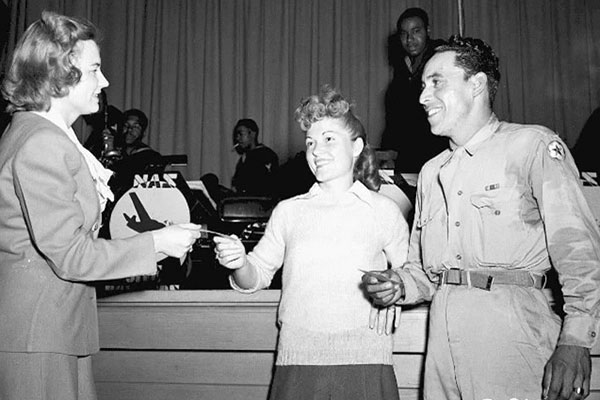
“The Tri-Cities were segregated during World War II,” says Gamboa, a doctoral student in history at Washington State University. “But in these types of social spaces, you see people of different backgrounds interacting.”
Valdez, a Latino serviceman, was working at Hanford. He and his partner were dancing to music by the NAS Jive Bomber, a traveling Black orchestra also shown in the photograph.
Gamboa dug into the US Department of Energy archives to document information about the Latino workforce in the Tri-Cities during the Manhattan Project.
About 150 people of Latino heritage moved to the area to work at Hanford during the 1940s, Gamboa says. Some had jobs in finance, administration, and engineering. Among them were Adolfo Linares and Ivan M. Garcia, who were both Puerto Rican. Linares moved from New York to work as a fiscal director at Hanford. Garcia was an electrical engineer. Others were laborers.
To recruit Mexican Americans from Texas, the War Manpower Commission advertised in Spanish-language newspapers and radio stations. But relatively small numbers applied. By only offering jobs to men and not providing housing for families, the jobs weren’t appealing to Mexican Americans, Gamboa says.
Gamboa’s research led to an exhibit displayed at the Kennewick Library, the WSU Tri-Cities campus, and the Reach Museum in Richland. His work offers insights about the early Latino community in the Tri-Cities, says Robert Franklin (’14 MA History), assistant professor of history at WSU Tri-Cities and Gamboa’s advisor.
“World War II is an important origin story for the modern Tri-Cities community,” Franklin says. “Latinos were part of a multicultural community that worked on the Manhattan project and the construction of the Hanford Nuclear Reservation.”