
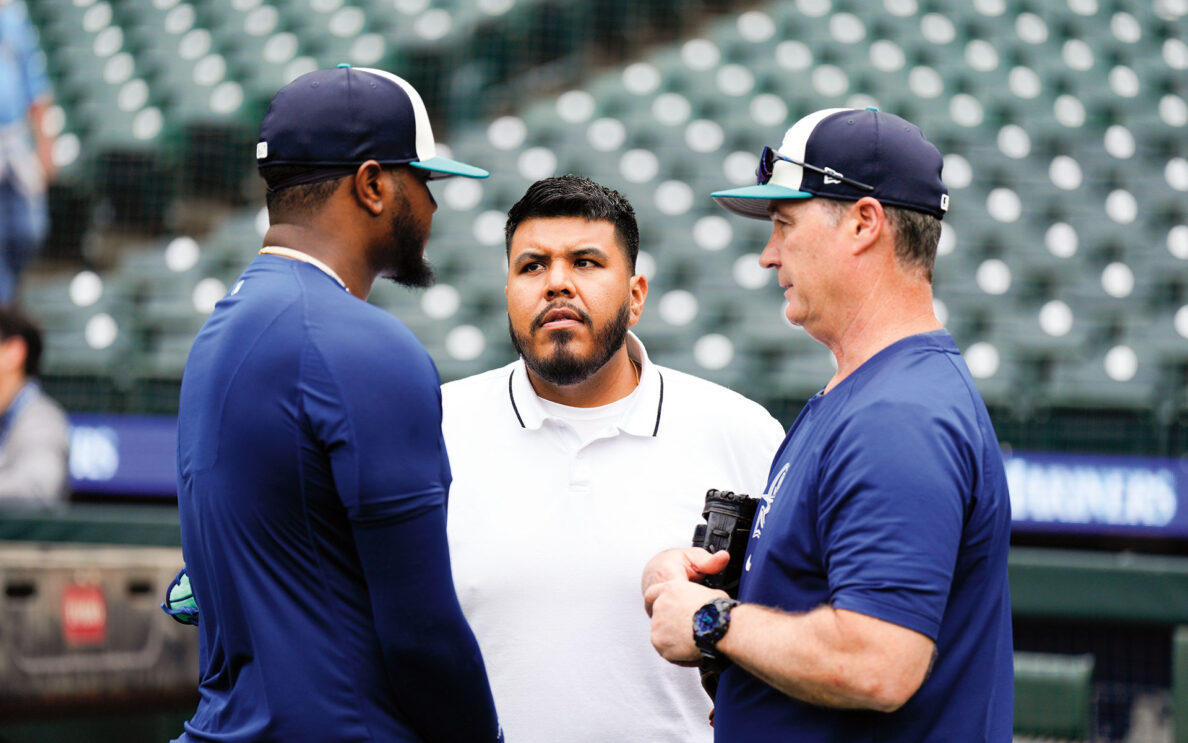
Jose Alfredo “Freddy” Llanos travels with the team.
He goes to all home and away games—162 in all during the regular season—often putting in 10- or 12-hour workdays. Find him on the field or in the dugout, assisting players such as Dominican pitcher Luis Castillo and Mexican pitcher Andrés Muñoz.
A senior communications coordinator for the Seattle Mariners, Llanos (’17 Comm.) serves as a translator for the team’s Spanish-speaking athletes, aiding with interviews as well as day-to-day interpreting needs. In his fourth season with the Ms, Llanos is typically the first person who Spanish-speaking players turn to for help talking with English-speaking journalists as well as understanding nuances in the language and American culture in their daily lives as professional athletes in the United States.
“Normally, every road trip, (the Mariners organization) will tell us what to wear. For example: Wear a polo with a jacket optional. Or, flying home to Seattle, you can wear your sweats. This time it was: Wear a sport coat. I walked in and found them all arguing: What’s a sport coat? The term meant four different things to four different players,” recalls Llanos, who was able to explain the term as well as find a photo online to illustrate it.
Major League Baseball has required teams to have at least one full-time Spanish-language interpreter since 2016.
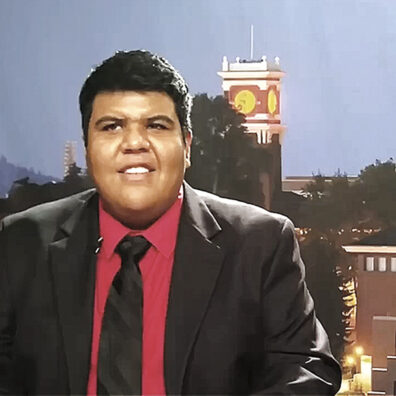
(From KING 5 video)
Llanos grew up speaking Spanish at home and learning English in school, sometimes missing class to translate for his parents at government and other offices. His parents, immigrants from Mexico who met in America, were farmworkers. His mom still is. She hails from the state of Sonora. His father, who now works construction and landscaping, is from the state of Nayarit.
Llanos credits them with his work ethic. “I’ve always seen my parents as hard-working people,” he says. “I’m very grateful to them.”
They followed crops around central Washington, bringing Llanos, the oldest of three brothers, into orchards at a very young age. “I knew if I didn’t go to college that was my future,” says Llanos, who participated in Gaining Early Awareness and Readiness for Undergraduate Programs, or GEAR UP, in middle and high school. The federally funded program aims to increase the number of low-income students who are prepared to succeed in postsecondary education.
His family settled in Tri-Cities when Llanos was in eighth grade and into soccer. “I’m the first in my family to make it past middle school, the first to go to college,” he says, noting he was also “a big number nerd” growing up. “I was always a math and science guy.”
He studied mechanical engineering at Washington State University. But his childhood dream wouldn’t let go. Ever since he could remember, he wanted to become a sideline reporter for soccer. He switched majors his junior year and began catching up on requirements for a degree in broadcast journalism. “It came naturally in terms of finding stories,” he says. But, at first, “I really struggled with the format. It was a whole new way of writing.”
Also new: being in front of a camera. “Growing up, I was very shy and quiet. On TV, you have to express your personality. That was a big challenge.”
Llanos was getting a haircut in January 2018, a month after he graduated, when he received a call from a Tri-Cities TV news director asking about his reel. “I had no idea what he was talking about,” recalls Llanos, who agreed to meet him at the station anyway. “It turns out my dad found my college newsreel on YouTube and posted it on Facebook for all of the Tri-Cities to see, and somehow it reached the news director.”
His first job—outside of picking apples and cherries alongside his mom during summers—was as a general news reporter at KNDU, the NBC affiliate where he grew up. “It was all in English,” Llanos says. “My parents loved watching me on TV, but my mom made the comment, ‘I can’t understand what you’re saying.’”
When a bilingual position opened at Telemundo in Tri-Cities, he jumped at the opportunity. “That kicked off my career on the Spanish side,” Llanos says. Although Spanish is his first language, “you don’t know how good your Spanish is until you’re reporting on-screen for a Spanish-speaking audience. I had an accent that people didn’t like. They could tell I spoke more English than Spanish, and that bothered people. I got a lot of bad DMs.”
Llanos spent two years perfecting his grammar and accent and developing his on-screen personality with the long-term goal of getting into sports reporting. That led him to his next stop: Oklahoma City, where he worked as sports director for Telemundo, anchoring the 5 and 10 p.m. sportscasts.
When his two-year contract expired at the end of 2021, he was ready for a bigger market. He returned home to Tri-Cities to regroup and apply for jobs. “I wanted to stay in sports, and I wanted to use my communication degree. I applied around the state and all over the country.”
The Mariners called in spring 2022, and Llanos made the switch from news to media and public relations—writing releases, helping prepare game notes, and translating for players “maybe once a month.” The Ms acquired Castillo that summer and, says Llanos, “that guy flipped my whole career. I was needed every day to help translate.”
He had never translated live on-air, let alone national TV, and sought advice from Japanese-language translator Allen Turner, who interpreted for Ichiro Suzuki. Focus on the overall meaning, not the exact words, he encouraged.
“I’m still learning, honestly,” Llanos says, noting there are players from Mexico, Dominican Republic, Cuba, and Venezuela. One of the most difficult parts of the job: “I had to get used to their slang.”
A lot of the job is building trust. With players. With baseball beat reporters.
Llanos has been on both sides. “When I was a reporter, I would reach out to the PR person to set something up. Now the roles are reversed. I think the biggest challenge for me was I love telling stories. I’m all about features and fun stories. When I first started, I found this really fun story, and it hurt me a little to give it away. Now I’m used to being able to give a good story to someone and trusting them to tell it well.”
Llanos got to put his Spanish-language skills to use when a Mexican soccer team, in town to compete against the Sounders, asked for a tour of the ballpark. “These are guys I grew up watching. It was a childhood dream-come-true for me.”
Typical game-day mornings, he helps prepare game notes, providing quick facts, stats, history, player info, seasonal context, and more to help print, radio, and broadcast sports journalists on the job. The game notes for the June 26, 2025, game against the Minnesota Twins—game No. 80, No. 41 on the road—ran eight pages.
Once members of the media and players arrive, his responsibilities switch to scheduling interviews, translating for interviews, and translating in general. “There are about seven players who will need me at some point, whether it’s for translating or moral support,” says Llanos, speaking from Minneapolis before a Thursday afternoon game.
He arrived Sunday after four days in Chicago and was leaving that night for Texas for three days. After a six-day stretch in Seattle, it’s off to New York and Detroit. “Once the last game ends, we’re on an airplane going to another city,” Llanos says. “Mostly, it’s three or four games and two or three cities. I’m kind of living the life of a professional baseball player without playing baseball. I’m in the stadium. I’m in the dugout. I’m in the clubhouse. I’m with the team all the time. I’m just happy to be here.”
Half his time is spent on the road, traveling to 81 away games. “I don’t have any pets, and all of my plants are fake,” he says, noting the 2025 season marked the first year he was slated to work every game, home and away, plus attend spring training. “I go down and live in Arizona for two months.”
The season runs from mid-February to early October or longer, depending on playoffs. “The off-season is when I take most of my vacation. I spend most of it with my family.”
Watch videos about Llanos and the Mariners
“Mariners translator aims to speak language of love” video (King 5, Sept. 25, 2023)
“From orchards to T-Mobile Park: Seattle Mariners interpreter shares life story” video (Fox 13, Sept. 23, 2024)