
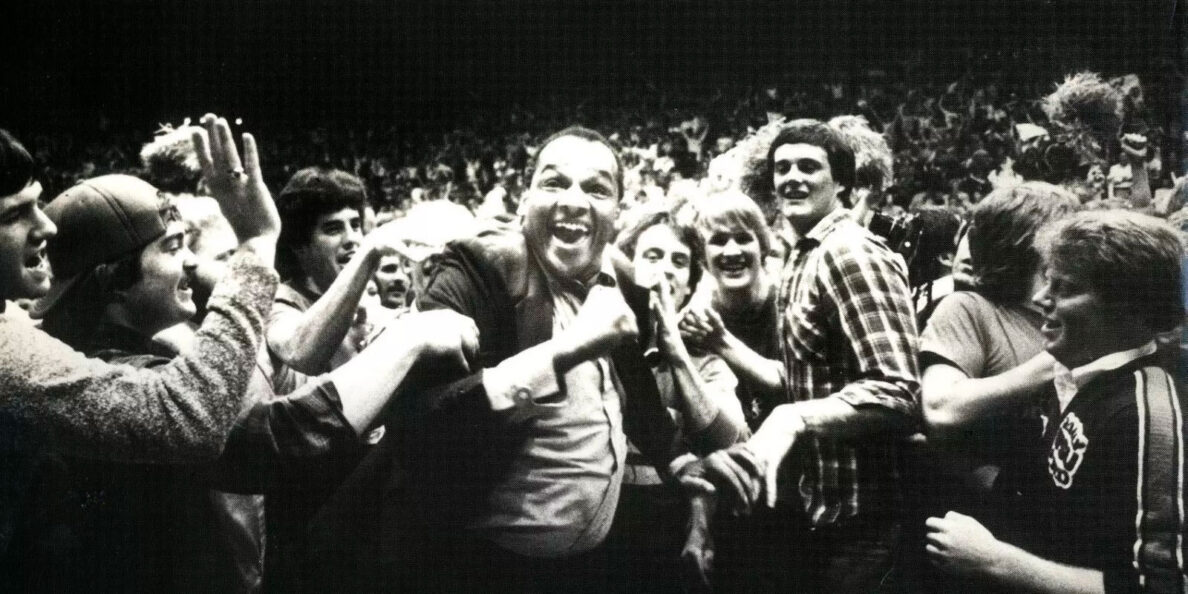
The crowd knew what to do.
When the beloved Coach George Raveling would wave both arms up in the air, Cougar basketball fans responded with an eruption of shouts and cheers. When he waved his arms down, they also obliged, filling the coliseum with a deafening silence.
The legendary Washington State University and Hall of Fame head men’s basketball coach who commanded the crowd and propelled the program to national prominence died September 1, 2025, at 88.
“George Raveling was an iconic figure not just at Washington State, but throughout the world of athletics,” former WSU Director of Athletics Anne McCoy said. “George is a Hall-of-Famer in every sense, and his positive impact on the athletics history at Washington State will continue to resonate through those he came in contact with, including student-athletes, staff, fans and alumni.”
The first Black head basketball coach at WSU and in what was then the Pac-8 Conference, Raveling came to Pullman in 1972 for what would become the longest stint in his coaching career. “And I loved every second of it,” he told Washington State Magazine in 2021, recalling his time at WSU as “a marriage made in heaven.”
The eleven years he spent at WSU “brought out the best in me as a human being. … I loved it there.”
If he got to do it all over, Raveling said, “I would—all eleven years. We might not have won the most games. But, as far as I was concerned, I had the best job on the league.”
Raveling served as WSU’s head men’s basketball coach until 1983, with a total of 167 wins and 136 losses. He was twice named the Pac-8/10 Conference Coach of the Year and twice took the Cougs to NCAA tournaments. The team’s 1980 appearance marked the first for WSU since placing second in 1941. He also took the team to the playoffs during his last season at WSU.
Before he came to WSU, he had never traveled west of Kansas City and had never worked as a head coach. “It was on-the-job training,” recalled Raveling, who moved to Los Angeles in 1986 as the head men’s basketball coach at the University of Southern California after three years at the University of Iowa.
He served as assistant coach for the 1984 and 1988 U.S. Olympic men’s basketball teams and was inducted into the WSU Athletic Hall of Fame, National Collegiate Basketball Hall of Fame, and Naismith Memorial Basketball Hall of Fame, which also bestowed him with its prestigious John W. Bunn Lifetime Achievement Award.
Standing 6 feet, 6 inches tall, Raveling played college ball from 1957 to 1960 for the Villanova University Wildcats, where he still ranks thirteenth in program history for rebounds, 835 in all. He received an honorary doctoral degree from Villanova, where he served as assistant coach from 1963 to 1969. He was assistant coach at the University of Maryland, where he became the first Black coach in the Atlantic Coast Conference, from 1969 to 1972.
In early 2020, Raveling returned to WSU to watch his name be raised to the rafters of Beasley Coliseum during a special halftime ceremony. He’s the only WSU coach to have that honor, and the moment brought tears to his eyes. “It was one of those extraordinary moments in my life when I could walk back and see some of the faces from early in my career and feel their warmth and have nothing but good memories. … I’m pleased that I made them proud.”
Addressing the crowd from the court that day, he began, “Thank you for bringing me back home.”
Asked later how he wanted to be remembered, he paused. “I just want to be remembered as a meaningful part of the community from a sport’s perspective. I want to be remembered as a person who loved every second of every day that he lived in Pullman, and I’m deeply honored and appreciate that I got to come back.”
In addition to his coaching career, Raveling is known for crossing paths with Martin Luther King, Jr. during the March on Washington on August 28, 1963, when the strapping young man by chance ended up working security for the famed civil rights leader on the steps of the Lincoln Memorial. After his I Have a Dream speech, Raveling spontaneously asked King for his copy of the address, and King handed it to him. In 2021, Raveling donated the typewritten pages with King’s handwritten notes to his alma mater, which lent them to The Smithsonian’s National Museum of African American History and Culture. The museum displayed the speech for the museum’s 50th anniversary, opening its “Defending Freedom, Defining Freedom” gallery beginning that August 28, the anniversary of the march.
After his coaching career, Raveling founded a consulting firm, Coaching for Success, and spent more than 20 years at Nike—as the director of grassroots, then global, basketball in sports marketing and, finally, international basketball—before retiring in 2016. He remained a voracious reader, typically reading several books at a time and often giving signed copies as gifts.
He also shared positive maxims via X, formerly known as Twitter, where he has nearly 39,000 followers. “The rest of your life can indeed be the best of your life,” he posted on August 26, six days before he died.
His final post, dated August 27, reads: “Embrace the dawn of a new chapter, for within its pages lie the untold adventures and limitless opportunities that await your self-discovery.”
Web exclusive
Stories about Coach Raveling, including memories from former Coug players
From the archives
Bring out the best (Summer 2021)
Can I have that, Dr. King? (Summer 2021)
Paying for keeps (Summer 2023: A Coug finds and returns memorabilia to Raveling)