
Women’s clubs gained momentum in America from the 1870s to the 1920s. Back then, smart, curious, and ambitious women found few other places to shape and display their talents outside of their own homes. Education and career opportunities were few and far between. For many, charitable work, particularly through church, was the only other outlet.
The format and formality of women’s club boosted their association with like-minded ladies. Some groups focused on studies: literature, history, geography. Others worked on service and reform, supporting the Red Cross and troops during World War I and II, launching scholarships for girls, organizing free milk clinics for mothers in poverty, and running campaigns for improved street lighting, environmental protections, and more.
Opportunities increased in the twentieth century. But many clubs continued to flourish, offering a sense of community, chance to network, and opportunities to learn and volunteer.
Small groups, like those in Pullman, typically held meetings in members’ homes held twice a month during the school year. Membership was exclusive, often invite-only. Women could be blackballed by just one or two votes. In general, members were white Protestant women of comfortable means and husbands in positions of local prominence, such as administration at Washington Agricultural College, later Washington State College, then Washington State University.
As time marched on, excluded populations founded clubs of their own. Attitudes changed, too, and women in groups previously shunned due to race, religion, or class were later invited to join. Bylaws were amended to become more inclusive, even if clubs remained invite-only.
Fortnightly is the longest-standing women’s club in Pullman. But it isn’t the only one. Two other women’s study clubs are also more than 100 years old and have ties to WSU. In fact, at one time, Pullman had as many as seven such clubs. Here’s a look at two of them.
Ingleside Club
Founded 1917
The first meeting of Pullman’s Ingleside Club took place on Monday, January 22, 1917, at the home of Mrs. T.H. Wright, secretary/treasurer of the newly formed club, established for service as well as the study of music, art, and literature. Six faculty wives and three “town women” attended.
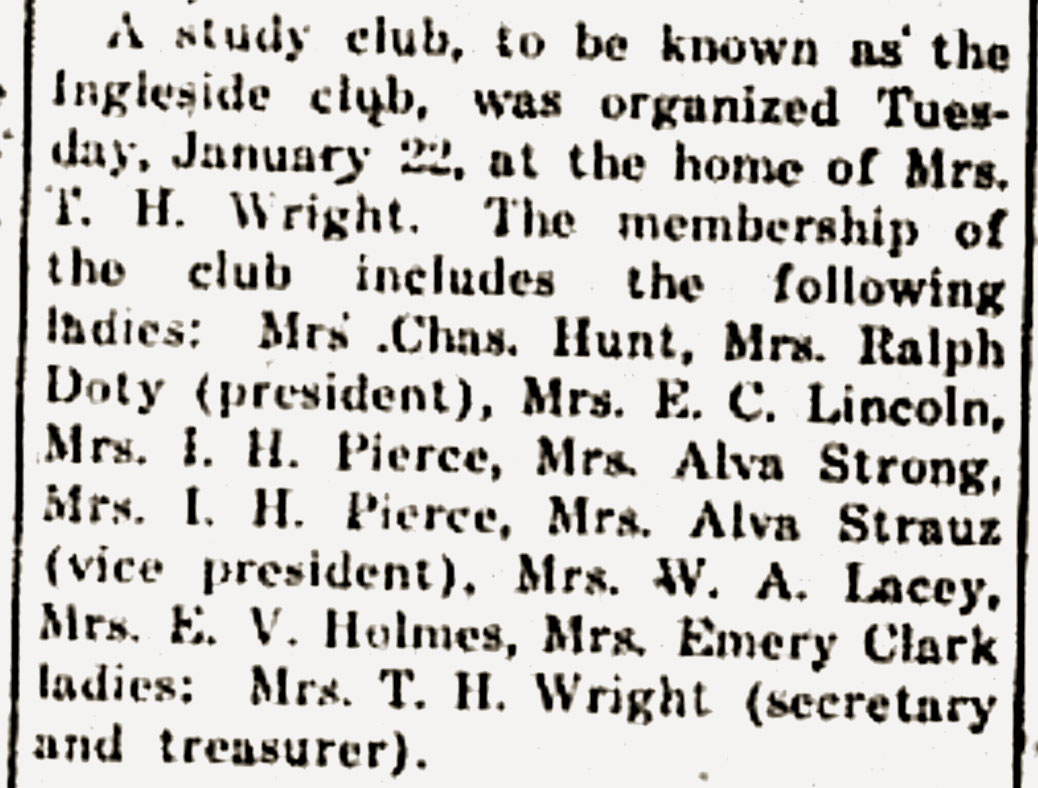
Wright didn’t stick around long. The May 25, 1917, edition of the Pullman Tribune reports: “Mrs. T. H. Wright left Saturday over the Union Pacific lines for Seattle, where she will visit relatives before going to Ames, Iowa, to make her home. Mr. Wright will leave soon to join her father at the latter place.”
Minutes from early meetings, preserved at WSU Libraries’ Manuscripts, Archives, and Special Collections, don’t reveal much, only where meetings were held and other formal actions such as the call to order, reading of the minutes, and roll call.
The club, for young married women, met every two weeks. A proposed 1986 change to the constitution, suggested meeting the second and fourth Tuesdays of the month, same as Fortnightly.
Its mission is similar, too: “the improvement and helpfulness of its members.” Members were required to present a paper on a predetermined topic and host at least one meeting per year.
(Source The Daily Evergreen, photo courtesy Rosalie Harms)
And, also similarly, the club holds a spring luncheon, affords lifetime memberships, and prints annual booklets with the yearly program, starting with the 1918-1919 academic year. These are also stored at MASC, along with the ledger used by the club treasurer from 1922 to 1992.
The club, like Fortnightly, is invite-only. Women could become members by snagging an invitation to one of two annual “Guest Days.” At the next regular meeting, members voted on whether to induct a guest into the club. Francine Barbara Terrell, wife of new WSU president Glenn Terrell, was a guest on October 10, 1967.
According to the original, handwritten constitution, just “one negative vote shall exclude the candidate.” That provision was amended in 1920 to let in a candidate with only one nay vote. Evidence of this actually happening is recorded in the minutes. On October 13, 1942, one candidate received an “unfavorable” vote. Her name has since been blacked out. Same thing happened on April 24, 1945, the woman’s name also scratched out and lost to history.
Many notable women from Pullman’s and WSU’s history were members, such as Helen B. French, wife of Charles Clement “Clem” French, the sixth president of WSU, and Ruth Wilhelmina Ellington, wife of Elmer Verne Ellington, director of the Agricultural Extension Service from 1946 to 1953.
Ingleside member Alice Merrill and her husband Thais, the chair of the horticulture department, moved to Pullman in 1946. According to her 1997 obituary, she was head resident at the now-demolished Kruegel-McAllister Hall and, in 1974, became house mother for Alpha Phi sorority. In 1977 she began substituting as house mother for various sororities at WSU and the University of Idaho.
Ingleside member Gwen Mooberry worked for more than 20 years in the comptroller’s office. She and her husband, Jack, moved to Pullman in 1945 for his job as head track and field coach at WSU, a role he held until 1973.
Women are identified by the courtesy title Mrs. along with their husbands’ initials and last names in meeting minutes through the 1950s. Their first and last names begin showing up in minutes in the 1960s. Local news outlets continued to identify women by their husband’s names at least through the 1970s.
An October 21, 1971, story in the Pullman Herald about the only remaining founding member still active in the club referred to her only by the honorific and her late husband’s name: Mrs. Carl M. Brewster. He was professor of organic chemistry at what would become Washington State University and had died ten years earlier. She technically joined the club at its second meeting, and she remained a member until her death in 1984. Her name was Alfhild (Nordby) Brewster, and she taught piano lessons.
In the newspaper story, she talked about the naming of the club, which happened at the first meeting: “ … the women had an image of sitting around the hearth socializing and they gave the group the name of Ingleside,” which refers to the warm and comforting space near a blazing fireplace.
The United States joined World War I about three months after the start of the club. During meetings, members did work for the Red Cross, mostly sewing. Civic improvement was a big focus of the club, which often collaborated with other civic groups. The club amped up their civic work during World War II. The May 8, 1945, meeting was canceled so members could celebrate VE Day.
The first typed minutes appear to be from April 25, 1989. However, minutes remained mostly handwritten until October 22, 1991. They become more detailed as time marches on, noting, in particular, the refreshments: lemonade and trail mixes, a “delicious pumpkin dessert,” Japanese green tea and Japanese dessert dumplings, a “wonderful plum dessert,” hot drinks and a lovely chocolate cake, “delicious pumpkin bread” and cookies, cranberry bread, “authentic English trifle.”
There are, of course, the books: A Walk in the Woods by Bill Bryson, Water for Elephants by Sara Gruen, Fast Food Nation by Eric Schlosser, White Bread by Aaron Bobrow-Strain, The Big Burn by Timothy Egan, The Kite Runner by Khaled Hosseini, The Absolutely True Diary of a Part-Time Indian by Sherman Alexie (’94 Amer. Stu.), I’m OK, You’re OK by Thomas Anthony Harris, and Into the Wild, Into Thin Air, and Under the Banner of Heaven, all by Jon Krakauer. They also read titles by Gay Talese, Paul Theroux, Wallace Stegner, and James Michener.
Pullman Historical Club
Founded 1904
Elizabeth Hungate started the Pullman Historical Club in 1904 with 10 members. When the group formally organized later that year, it boasted 19 members. The club met every two weeks to discuss Shakespeare, other authors, and mostly history. Activities also included community service, hosting themed luncheons as well as guest speakers, and taking field trips, such as a 1978 visit to the WSU Planetarium.
Meetings were run like Fortnightly and Ingleside, with one-hour presentations, often on a historical topic: Japan, Russia, Germany, France, China, Spain, Holland, Egypt, New Zealand, Australia, Greek theater, art of the Florentine Renaissance, the Lewis and Clark expedition, the life of Louis Leakey, the Guggenheims, and immigrant contributions to American life.
(From WSU Libraries microfilm scan)
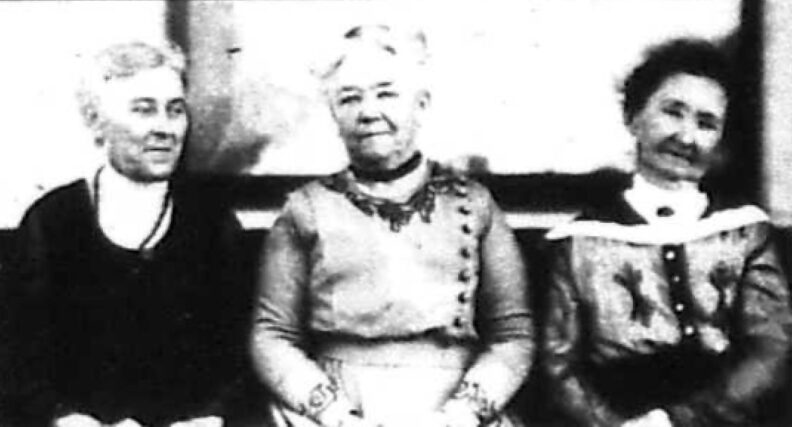
Meetings took place on the second and fourth Tuesdays of the month, same as Fortnightly and Ingleside. The aim, like the other two clubs: “mutual improvement of its members.”
During the 1943 to 1944 academic year, members helped register Pullman residents for ration books. They also donated funds to the United Service Organizations (USO).
Like those of Fortnightly and Ingleside, club records are preserved at MASC. Many members have ties to WSU.
Former WSC student Ellen Klemgard was club president from 1951 to 1952. She was married to Edwin Neal Klemgard (1922 Chem. Eng.), the first port commissioner of Whitman County, winner of a WSU Alumni Achievement Award, and 1977 Colfax Man of the Year.
Signe (Byrd) Bustad (’41 Home. Econ.) was club president from 1979 to 1980. She was married to Leo Bustad (’41, ’48 MS Ag., ’49 DVM), dean of veterinary medicine at WSU from 1973 to 1983.
Are you a member of the Pullman Fortnightly Club, Ingleside Club, or Pullman Historical Club? Share your experiences with the long-running literary organizations by writing to wsm@wsu.edu.
Women’s clubs across Washington state
Washington State Federation of Women’s Clubs is founded in 1896 when 22 women’s clubs convened to write the constitution for a federation of clubs across the state to share reports on group projects in literature, art, music, science, and current events.
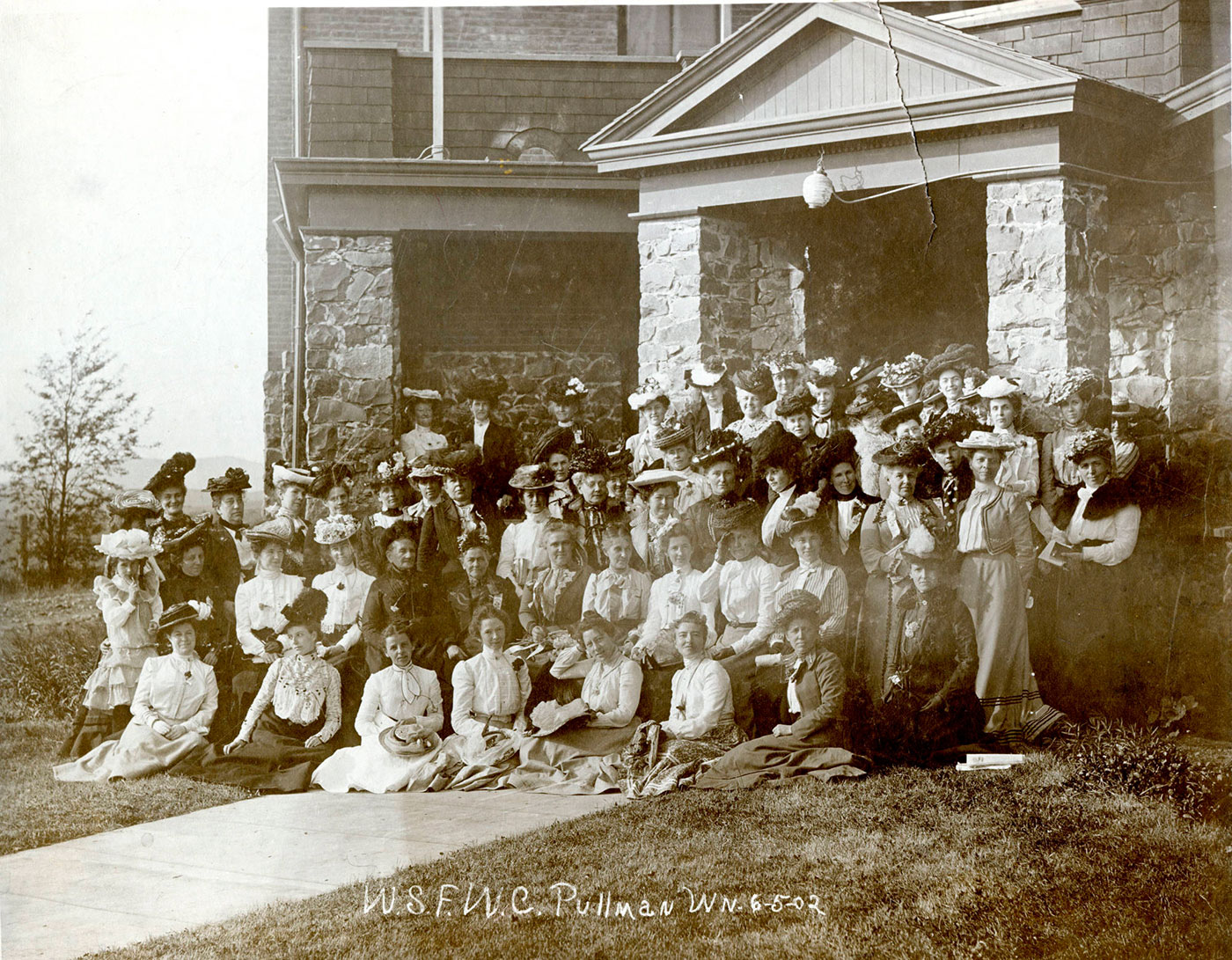
From the beginning, WSU hosted many of the annual meetings with Pullman club members in attendance.
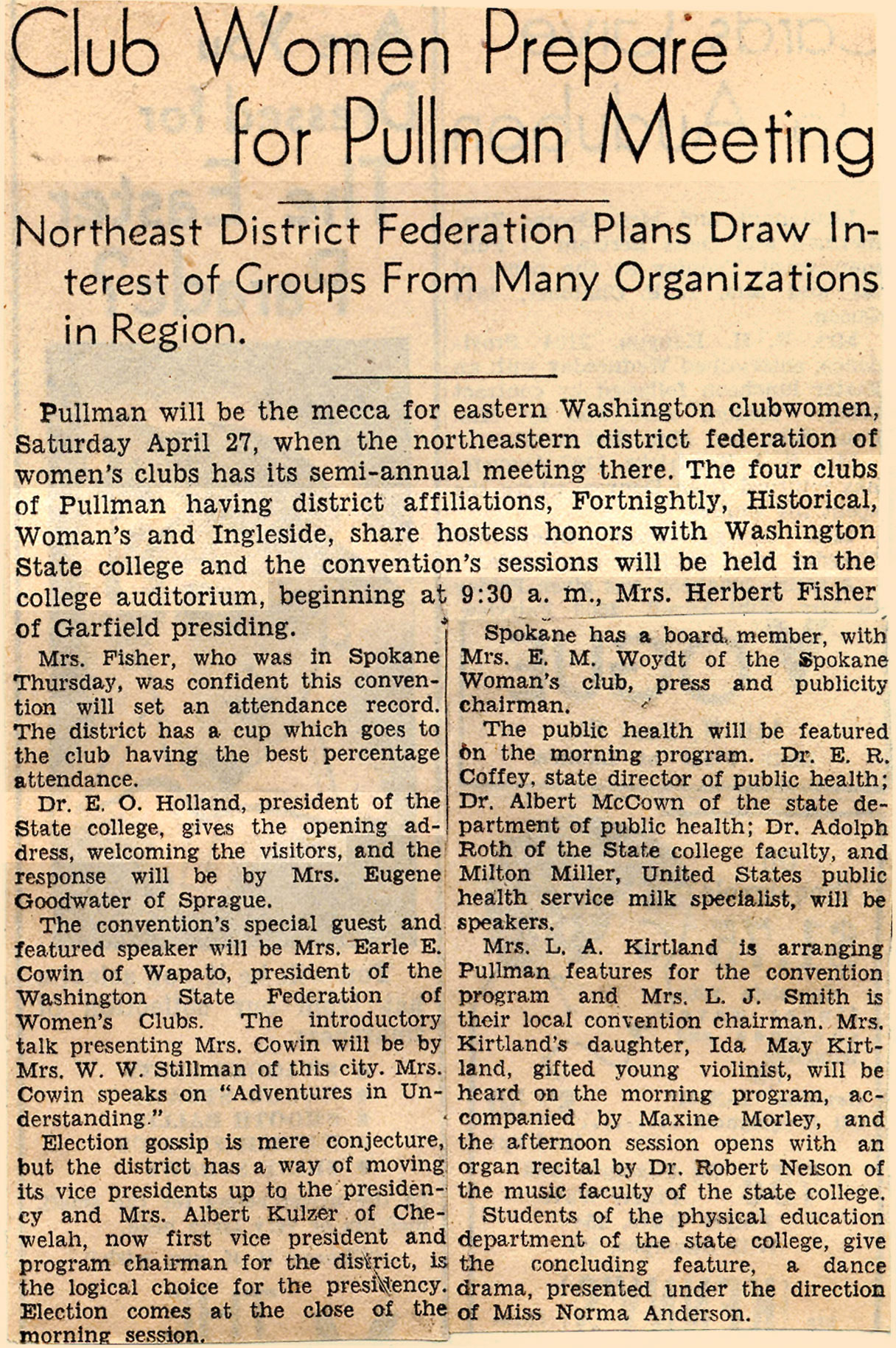
There is more information on the WSFWC in this HistoryLink.org essay.
Here is a slideshow of various newspaper clippings regarding the WSFWC, Pullman Women’s Club, and Pullman Garden Club—courtesy WSU Manuscripts, Archives, and Special Collections.
More stories of book clubs
Fortnightly Club of Vincennes, Indiana
The Fortnightly Literary Club of Indianapolis
Vashon Great Books Club One of the Oldest in the US (Seattle Times)
Fullerton’s Wednesday Book Club Turns 90 Years Old (Fullerton Observer, Feb. 2, 2024)
A lot has changed in 150 years, but not the Fall River Book Club (Everett Herald, May 25, 2015)
Port Clinton’s 88 Circle book club celebrates 136 years
Alberta book club hits 90th anniversary by keeping things interesting (CBC)
These Book Clubs Have Been Around for Over 100 Years
Timeline of the Evolution of American Book Clubs (Minnesota Post, September 2009)