
Hear from members of the Pullman Fortnightly Club in their own words. These memories are excerpted from “Reminisces of Members,” compiled for the 110th anniversary dinner in 2003, unless otherwise noted.
Hattie Bryan
Joined in 1893
From her speech titled “On the History of the Founding of the Fortnightly Club,” delivered November 23, 1908, for the club’s 15th anniversary
“I remember the day we landed in the village at the old Northern Pacific station … Raining! I think I never saw it rain harder, and mud! How the struggling horses ever managed to get us through it, up to our rental home, on ‘Sunnyside’ … I thought Sunnyside, indeed! The sun did not appear for a month; and then came snow … “
Due to the Panic of 1893, “gloom and despair had settled down upon many houses … yet here we were and some of us at least felt the responsibilities upon a college community of literary development. It fell to (me) to call together a few choice spirits to chat over the teacups the possibilities of an organized effort in this direction.”
Hattie Bryan’s 1908 speech about the founding of the club
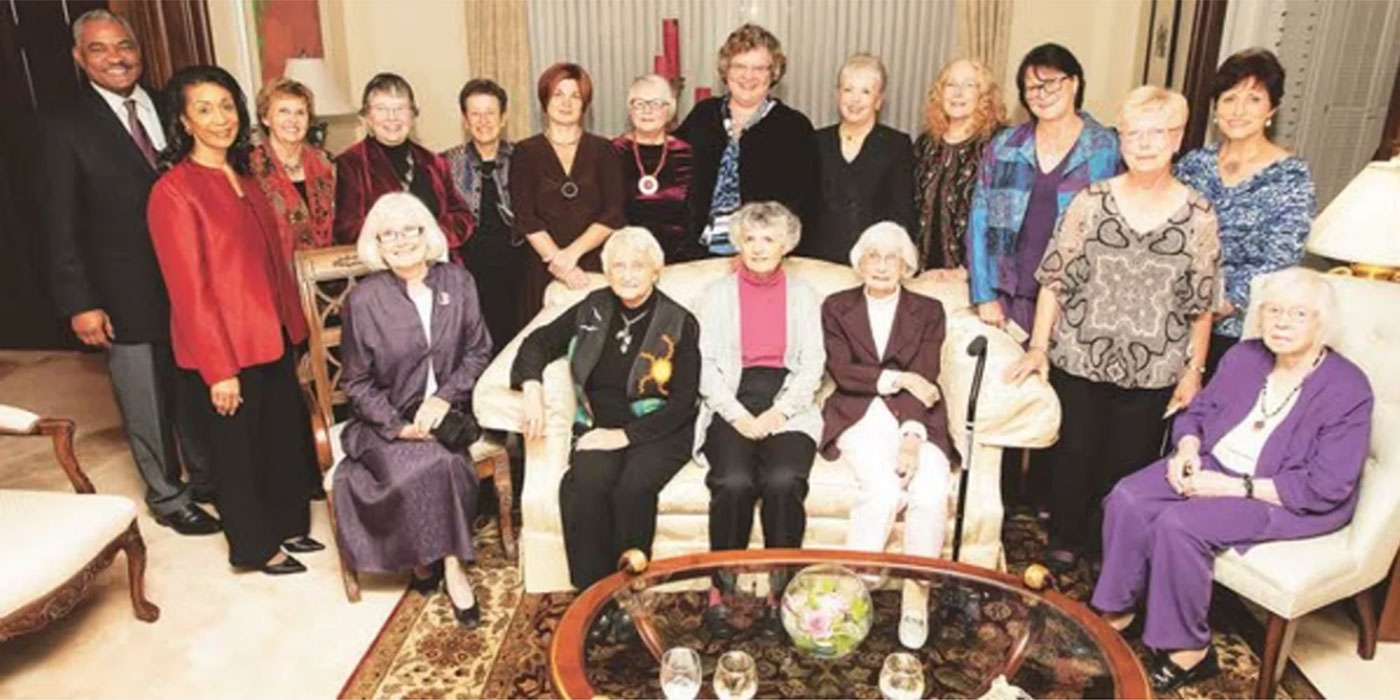
(Photo Dean Hare/Moscow-Pullman Daily News)
Judy Sorem
Joined in 1968
“When I first moved to Pullman, I recall seeing a picture in the Pullman Herald of several Fortnightly members, including the lovely Kate Batey wearing white gloves and a beautiful picture hat. I thought to myself then that it would be wonderful to be a member of that club. A couple of years later I was invited to join, and I am pleased to say that overall, it has been an enjoyable experience indeed.”
Jo Culver
Joined in 1962
“I have met many delightful and very intelligent women whom I could never have met otherwise, and these all possessed one trait in common—their love of books. Many also had a variety of individual interests as well: music—both teachers of music and performers, including one saxophonist, as well as a beautiful singer; a potter, the first lady mayor of Pullman, several city council persons, some professors, some librarians, a minister, quilters, etc. The books, their authors and the insights of the reviewers have added a tremendous pleasure to my life.”
Dorothy Swanson
Joined in 1961
“Fortnightly Club greatly expanded my reading interests and through it I learned about many other areas of the world. André Malraux’s history of art, The Great Hunger in Ireland, the South Slavs on the Balkan peninsula, South American literature and the writers of India, and Pierre Teilhard de Chardin’s The Phenomenon of Man were a few of the new adventures. My 10-year-old granddaughter wrote, ‘Live to do what? Read!” As I contemplate a year of Fortnightly programs, I’m tempted to join in her sentiments.”
Laura McMichael
Joined in 1977
“When I joined, members properly wore skirts and often heels, and conversation seemed a bit more polite, careful, and kind as I remember. Such characteristics are still there but I feel that now the women are more real and honest about their own feelings. I remember Mary Stevens saying that our Fortnightly Club should be called the Forthrightly Club. That characteristic of members knowing their minds and speaking up on issues with knowledge and differences of opinions in a forthright manner has always been a wonderful characteristic that I have enjoyed.”
Nancy Collins-Warner
Joined in 1996
“What I love most about Fortnightly is being in the company of so many remarkable women. I watch and learn from each one, especially about how to handle life’s vicissitudes gracefully. It is serendipitous that our love of books and reading brings us together.”
Belle Rogers
Joined 1983
“Fortnightly is good books, good friends, good times, and new ideas.”
Jennie Brown
Joined in 1983
“Fortnightly has meant and does mean—
- Good friends—remarkable women I might never have known, certainly not as well.
- Widening of literary appreciation; books I might never have heard or—or run into.
- A deep and deepening respect and interest in the history of Fortnightly and the women (who started it).
- Even with all that respect I am glad we are a more relaxed, less formal group—they would have been too stuffy for me.
Kelma Short
Joined in 1957
“Fortnightly was, I think, considered the most seriously intellectual book club in Pullman. We took ourselves very seriously. Our meetings quite formal and disruptions, such as the ringing of the telephone during the program, were not tolerated lightly. An illustration—I had been a member only a year or two and I took my mother-in-law, Ruth Short, as my guest. She was wearing her grandmother bracelet which consisted of eight silver discs on a chain. As it happens, Ruth had a cold and frequently needed her hankie. Every time she opened her purse to retrieve her hankie, her bracelet would jingle, and I was terribly embarrassed. Back in the fifties, this disruption was a social faux pas at Fortnightly.
“The format of Fortnightly Club has basically stayed the same over the decades, but I am very. Happy that the tenor of the meetings has changed to a more casual atmosphere. We don’t take ourselves as seriously and we even interrupt the program if we have a comment during the presentation. Casual and lighthearted is more enjoyable and relaxing then the stuffy atmosphere of the past.
“However, stuffy or casual, Fortnightly Club has done more to broaden my literary horizons than I ever could have imagined. It has exposed me to so much literature that, on my own, I (never) would have ventured into. I am sure that, because of this, I am a more knowledgeable person and, I hope, a more interesting one.
“And not the least of many benefits —the wonderful friends that I have made over the years as a member. Fortnightly women are a kind of ‘sisterhood,’ and once a member, always a member. I am very fortunate to be part of a club that has been so important to so many women for a century plus ten years.”
Karen Kiessling
Joined 1972
From her speech titled “The Founding of the Fortnightly Club,” delivered during the organization’s 120th anniversary dinner in 2013
“I treasure my membership in Fortnightly as it is my single-most intellectually stretching event in the year. I have met writers I would never have found on my own, read and talked about stories that gave new ideas and challenged settled notions. Fortnightly is work, it is fun, and it is worthwhile. It is a treasured part of my life.
“I think of Hattie Bryan, riding that train in 1893, from Indiana to the wilds of the fledgling Washington State College and carrying that elm tree seedling. What she planted in Pullman with Fortnightly was a far greater gift to the 277 women who have been enriched by Hattie, who first called together a few ‘choice spirits’ to talk ‘of literary development.’”
Karen Weathermon
Joined in 2023
Emailed comments to Washington State Magazine, spring 2025
“I’m a newish member of Fortnightly, having joined in late spring in 2023. I’ve been attending as I can for the past two years but presented my first book only this spring. So I’m rather new to all the traditions and practices of Fortnightly. But I’ve known about it for many years because I have several longtime friends who have been members and who have spoken through the years about how much they have enjoyed the group and have learned from being a part of it. I also was ‘Fortnightly-adjacent’ for several years because it was not uncommon for me to be contacted by someone serving on the Executive Committee (those who select the theme and the books to be read in the coming year) for ideas I might have about books. My WSU work with the Common Reading Program has meant that I receive news about new releases and often copies of the books themselves; thus, I’ve served as a resource for possible titles on a given theme on several occasions.
“Fortnightly’s history and its seriousness of purpose actually is part of what appeals to me about being a member—in addition to my regard for the members I already knew before joining. It is certainly a book club that takes the selection of and programs on books seriously, asking that the presenters and members read and think critically and carefully about the titles selected. I love learning, and so that aspect of the club appeals to me. Fortnightly’s history of that kind of serious engagement for over 100 years also intrigues me; it feels like being part of something that has been significant in Pullman for a long time. In doing my own presentation this spring, it actually felt a bit like a return to my graduate work in English as it has been a long time since I’ve been called to do any research on an author or on the critical response to a work. I enjoyed flexing that muscle again! And I’m already beginning to think about the title I’ve been assigned for next year.
“The ‘formalities’ of Fortnightly are still aspects I’m getting to know. The daytime meeting times mean, of course, that the group is comprised primarily of women who are not currently in active professional roles. I didn’t join the group myself until I knew I was headed toward retirement, thinking that I would participate as best I could while still working but that it would also be a bridge into post-retirement engagement. A couple of current members, however, have managed to participate actively while working (Donna Potts, Julia Pomerenk). The option of Zoom meetings has also made attending a bit more flexible, and I appreciate that—both for members who no longer live in Pullman, but also for those who can’t get away from work physically but who may be able to attend online. Aside from the meeting time, the other formal aspects are ones I’m just getting to know. I recognize that they are in many ways a throwback to the era of the group’s founding. They aren’t the reason I joined, but they don’t strike me as being especially problematic either. For me, really, it is the reading of interesting books and having good conversation about them with others that is the primary appeal.”
Donna Potts
Joined in 2022
“I may well be the only person who was a member of both Fortnightly and Ingleside. Karen Kiessling invited me to speak at the spring luncheon because she’d heard my talk on Nancy Van Doren, former Fortnightly member. My Fortnightly talk was delayed because of the pandemic, and, meanwhile, Kathy Meyer invited me to join Ingleside, subject to a vote. When I finally gave my talk to Fortnightly, Karen invited me to join, apparently the first guest speaker to be invited to be a member. I said yes because I hadn’t heard anything about the Ingleside vote. Immediately thereafter, Kathy invited me to join Ingleside, and I said yes, never dreaming that they met on exactly the same days and times. I attended both for a few years, but when I went on sabbatical to Ireland and got a job in New York, I had to resign from Ingleside because they didn’t offer a Zoom option. I greatly appreciate Fortnightly’s efforts to accommodate working members by embracing Zoom and providing opportunities to present at a time that fits better with one’s work schedule—adapting to the 21st century while honoring the previous ones!”
Anniversary speeches on the Fortnightly Club’s history
Reminisces on the History of the Founding of the Fortnightly Club
By Hattie Bryan
Fortnightly Club founder Hattie Bryan read this speech at the group’s open meeting on November 23, 1908, in celebration of the organization’s fifteenth anniversary. Bryan established the women’s study group in 1893, the same year she arrived in Pullman, where her husband served as the third president of what would become Washington State University.
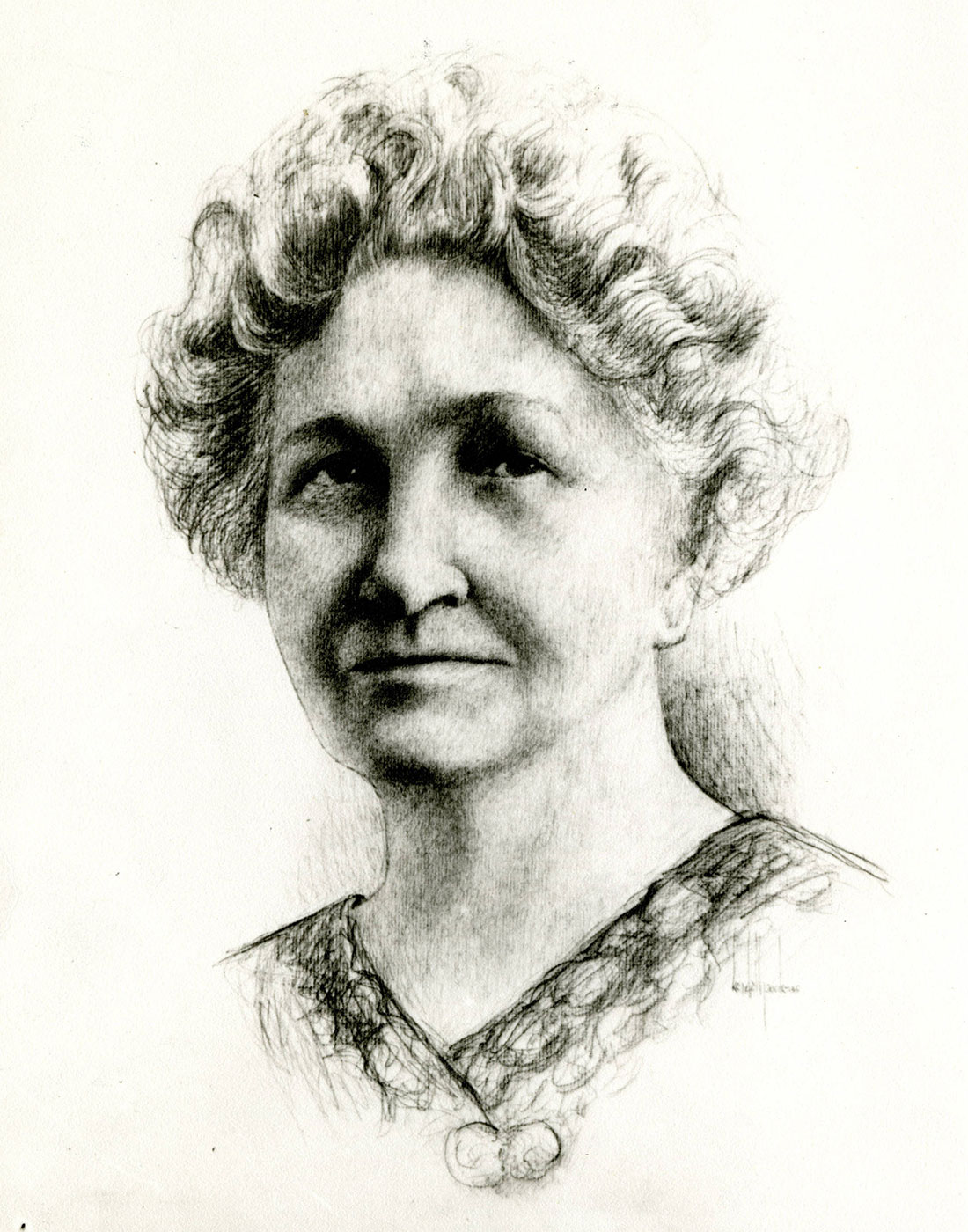 Illustration of of Harriet Williams Bryan by Kendall Poole
(Courtesy WSU Manuscripts, Archives, and Special Collections)
The year 1893 was one long to be remembered by the people of the United States.
The Great Panic had ruined its thousands and the great depression which followed had plunged its ten thousands into poverty and want. Here in Washington, where the earth yields so bountifully, it would seem that want could not dwell. But those who had come to make their fortunes did not bring much money with them, and so borrowed, at ruinous rates, and when the panic came were able to pay neither principal nor interest. To make matters worse the unusual had happened as it always does. Namely, the weather was unusual. I well remember the day we landed in the village at the old Northern Pacific station, not where it now stands but up the track where the coal bunkers are. Raining! I think I never saw it rain harder, and mud! How the struggling horses ever managed to get us through it, up to our rented home, on “Sunnyside,” named in jest I thought, to the house belonging then and now to Mrs. Jaberg. Sunnyside indeed! The sun did not appear for a month, and then came snow, and more mud.
We had not brought the rain with us, for it had been raining for a month, and the poor farmers, who had always counted on harvesting in September and October, and on leaving the sacks of wheat piled in the field, were in despair, for one half of the crop was standing in the field ruined, and the other half was in the field piled in sacks rotting.
In trying to orient myself, I inquired the way downtown, and was directed to “follow the trail” over the hill, for most Pullman streets were then guiltless of walks.
The very first night we spent in the town, a murder was committed in the Artesian Hotel, and I wondered if that was a western custom. Wood stoves, and coal oil lamps were the universal rule, for the electric light plant had … out with the panic.
There were three telephones in town, one at the college and one at each rail station. The big stores were tottering or had already fallen.
The high bleak boys’ dormitory, afterward called Ferry Hall, and the red wooden building known as College Hall made the campus look bleaker. The campus was then a corn field. There may have been a thousand people in town but I doubt it.
Gloom and despair had settled upon many homes, where a few months before, there had been bright expectations and fond hopes. Yet here we were, and some of us at least felt the responsibilities upon a college community, of literary development. It fell to the writer to call together a few choice spirits to chat over the tea cups the possibilities of an organized effort in this direction. So far as I can learn, there were not more than a half-dozen women’s clubs in the state at that time. The ladies who that evening in early November 1893 gathered about my tea table were Mrs. Van Doren, who at a little later period served as chairman of the first executive committee and also as a member of the committee on constitution, Mrs. Elton Fulmer, Mrs. O.L. Waller, Miss Annie Howard, Mrs. Lake, wife of Prof. Lake of the Dept. of Agriculture of the College, Mrs. Saunders, wife of the head of the Mechanical and Electrical Department, Mrs. George H. Watt and Miss Bessie Williams, all except my sister being members of the faculty of the College or wives of members. The “idea” of the club met with a hearty response, and the ideals of the club as they afterwards developed began to appear, and even the name Fortnightly came to the surface, largely I fancy because we spent some time looking over the program or year book of the Fortnightly Club of Old Vincennes of which the writer had been a member.
It was agreed to invite a number of ladies to unite with us for the purpose of perfecting an organization, and Mrs. Fulmer’s home was appointed as the meeting place. Mrs. Fulmer then lived where Mrs. Howell now lives, just back of Mr. J.J. Murray’s residence. A week or so later Mrs. George Lilley, wife of the ex-president Lilly, Mrs. Walter Windus, Mrs. Morrell, Mrs. Wm. Walis, and Mrs. H.J. Jackson, in addition to the ladies before named, met at Mrs. Fulmer’s and discussed the plans of organization; appointed a committee on constitution and prepared for immediate activity. The next meeting was held at the home of Mrs. Lilley on Nov. 27th at which time a constitution was adopted and officers were elected. It was agreed that the membership be limited to 25 and that rule has ever since been adhered to. It was also determined that there should be none but active members, and that everyone should do the work assigned her, or if she did not do so would by reason of neglect be dropped from the rolls. It was further agreed that the chief purpose of the club should be literary study and discussion. The successive programs show a remarkably consistent development along this line.
Mrs. Stacey of Tacoma, known as the “Federation Mother,” once being asked for advice as to a program for a club to follow, said, “Read the program of the Pullman Fortnightly as an excellent model.”
Sometimes, perhaps it has involved pretty strenuous work, and perhaps has not always been relieved as much as it should have been by purely social functions, but no one who has been a member, for any considerable length of time, and who has followed its traditions, can fail to have been greatly strengthened by its curriculum.
Four years after organization the club joined the state federation and has been represented every year since in the state meeting. Once with assistance and cooperation of ladies of Hist. Club we entertained the state federation very successfully.
Every five years the anniversary of the founding has been celebrated, this being the third—the crystal wedding as it were.
In the study of literature as a rule only virile authors have been pursued—Shakespeare, Browning, Ruskin, Emerson, Carlyle, Goethe, Ibsen, Tolstoy, Dante, and some of the club has plunged into Greek tragedy. The ethical rather than the philosophical aspects have as a rule received greater attention. Not very often have we wandered into the mysteries of religion, or the vagaries of politics, or the profundities of economics.
The discussions have often been lively and were of greater volume by reason of a certain ability of the members to hear and speak at the same time, so that several could speak and all hear at once but as to parliamentary procedure I think those clubs very foolish who worry much about that. Their stilted formalities come no nearer determining the will of the members than do our rather informal methods.
I cannot speak of the many interesting lectures given under the auspices of the club, our attempt at a library, our park efforts, nor other activities which have entered into our history. I can only say that there are many of us who love Fortnightly and who have found in it a source of strength, and light, and a better intellectual life.
Reminisces for the 70th anniversary: 1893-1963
By Catherine Mathews Friel
The Fortnightly Club, the oldest study club of Pullman, Washington, was organized 70 years ago in November 1893, through the interest and efforts of Mrs. Enoch A. Bryan, soon after her arrival in Pullman, when her husband, Dr. Bryan, assumed his duties as president of the state college. She called together at her home a number of the women belonging to the faculty, faculty wives, and wives of community businessmen, and proposed the organization of a women’s literary club. While living in Vincennes, Indiana, where her husband was president of Vincennes University, Mrs. Bryan was active for ten years in a club called The Fortnightly Club, because of their bi-monthly meetings.
In addition to her deep interest in the Fortnightly Club of Pullman and the State Federation of Women’s Clubs, Mrs. Bryan organized the wives of the faculty of the Washington Agricultural College into a social club which is the present Faculty Women’s Club. The Faculty Wives Club originally met at the president’s house once a month and Hattie E. Bryan, the founder, served as president until the retirement of President Bryan in 1916.
A second meeting was held at Mrs. Elton Fulmer’s home (Mrs. Fulmer was (the) wife of the head of the chemistry department). It was decided to invite other women to join. At a third meeting, held at Mrs. George Lilley’s home (Mrs. Lilley was the wife of the ex-president of W.A.C.), the club was formally organized, a constitution adopted, and officers elected. Mrs. Bryan was the first president and Mrs. Nancy Van (Doren), the chairman of the first executive committee. Mrs. Van (Doren) was the teacher for whom the new home economics building was named which is at present the music building. Charter members of the newly formed club were the following twelve women: Mrs. E. A. Bryan, Mrs. George Lilley, (Mrs. Nancy Van Doren), Mrs. O. L. Waller (whose husband was the vice president of the college), Mrs. (George) Watt (wife of a local druggist), Miss (Bessie) Williams (sister of Mrs. Bryan), (Miss Annie Howard), Mrs. Walter Windus (wife of a Pullman banker), Mrs. C. O. (Morrell), Mrs. W. B. Wallis (wife of (a) business man and Serena F. Mathews’ mother and Catherine M. Friel’s grandmother), and Mrs. H.J. Jackson.
It was agreed that the club should be one for literary and cultural study, the membership should be limited to twenty-five active members, and that the name should be The Fortnightly Club of Pullman. Also it was agreed that study work assigned must be done or the failure to do it would be considered automatic resignation.
It is not possible to list the many great authors and their works which have been studied. Classics from the literature of the English, American, French, German, Russian, Italian, Spanish, Indian, Oriental, and other great cultures have been evaluated. An effort has been made to also keep abreast of the modern writers, their styles, and philosophies.
Sometimes, this research study has involved strenuous work for the members but for any member who has belonged to Fortnightly for a length of time the reward has been one of great enrichment. For over forty years two literary club papers were presented at each meeting followed with a formal discussion held by the members. The meetings lasted from 2:30 to 5:00 p.m. with no refreshments served. Then new legislation dictated a shorter meeting with one paper given, followed by the business meeting and a coffee hour. Meetings to be from 2:00 to 4:00 only.
It has become a tradition that each fifth year’s anniversary be observed by a special celebration. This year, 1963, marks the fourteenth quinquennial. The special nature and programs of the anniversary have been as varied as the number of quinquennials themselves. The fourth one, in 1913, was a banquet at the home of Dr. and Mrs. Bryan on campus.
Memberships in Fortnightly are usually of very long duration because of the happy fellowship of minds. Time itself has proved to be the greatest factor in the slowly, but ever-changing personnel of the Fortnightly Club.
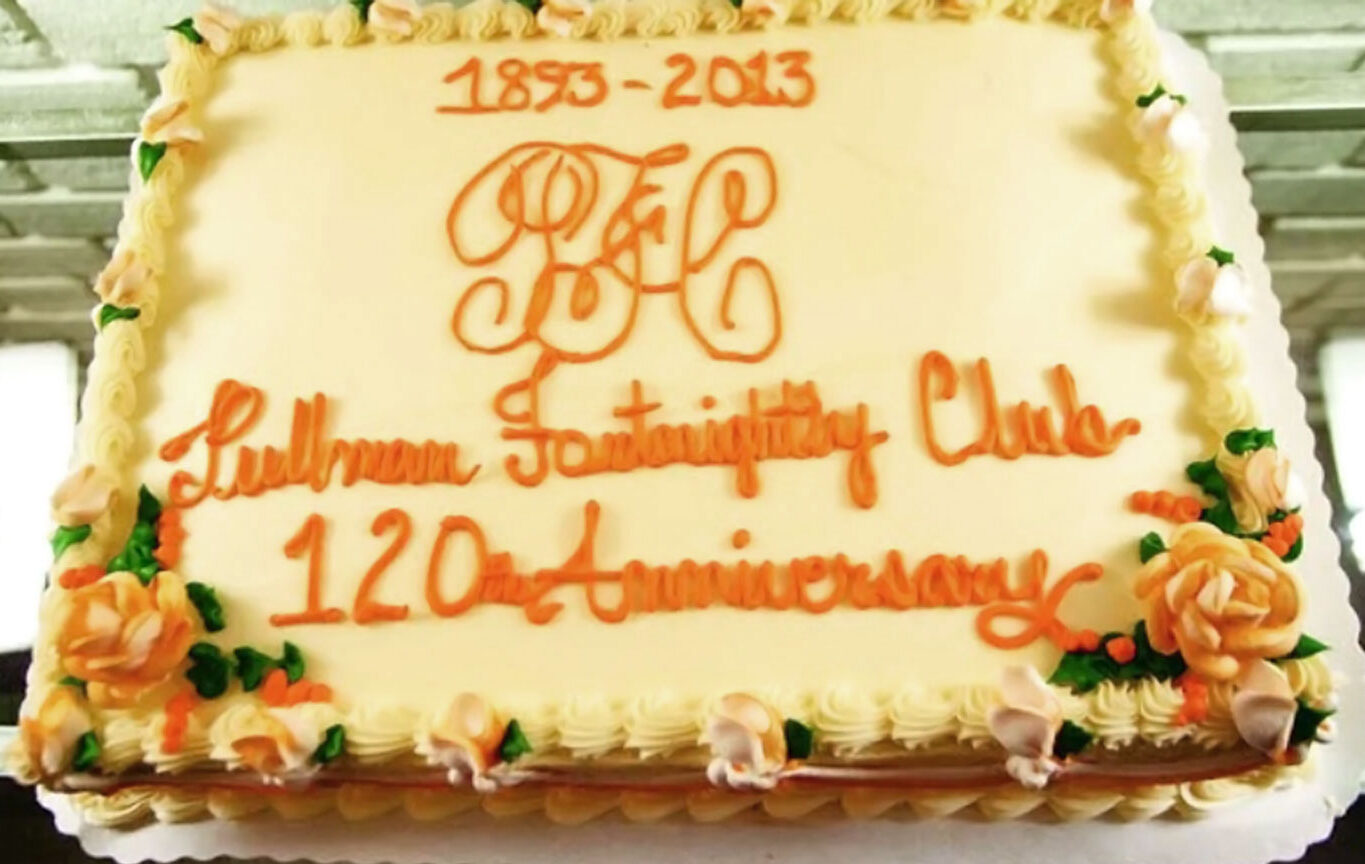 The 120th Anniversary celebration cake for the Pullman Fortnightly Club on Tuesday, Oct. 8, 2013, in Pullman
(Photo Dean Hare/Moscow-Pullman Daily News)
Read more
And ladies of the Pullman club
The long history of other Pullman literary and history clubs
Biographies of the 12 charter members of Fortnightly Club
(PDF, courtesy WSU Manuscripts, Archives, and Special Collections)