
When David Christenson was ready to give up on golf, another Coug had just the right words of encouragement.
“My wife said, ‘Hang in there. You’ve only been back in the game for two years. Things will turn around,’” says Christenson (’91 Soc. Sci., Gen. Stu.).
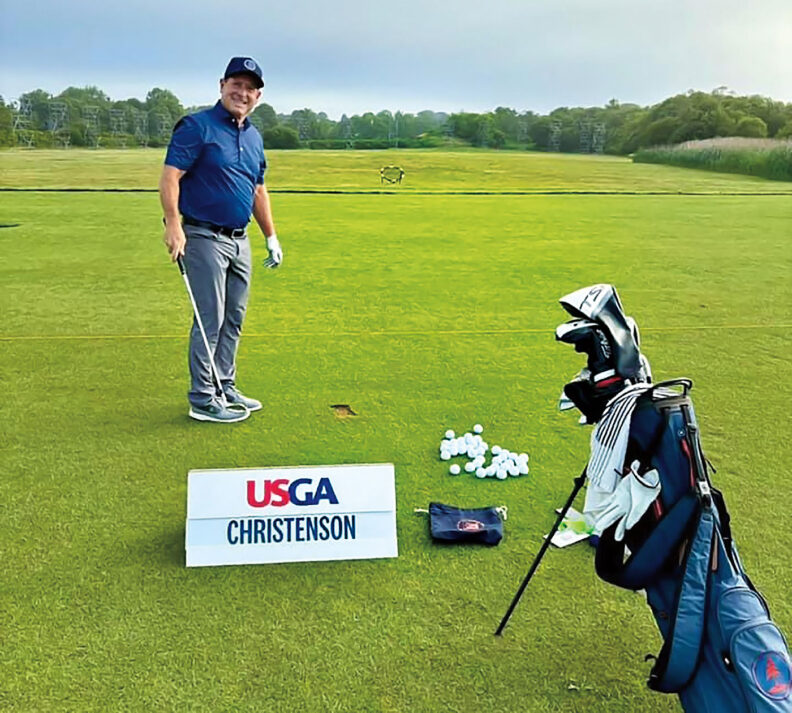
Jennifer Christenson’s (’91 Hort.) support helped propel her husband in late June to the US Senior Open, where he had the chance to play practice rounds with PGA Tour Champions Brett Quigley and Pádraig Peter Harrington and experience the Newport Country Club in Rhode Island. Founded in 1893, the historic golf club was a founding member of the United States Golf Association.
It was a pinnacle experience for Christenson, 56, who’s been playing golf since he was a youngster using a 7-wood iron to hit balls in his Spokane neighborhood. “I signed my very first autograph at the US Senior Open,” he says with a chuckle. “A little kid asked me for it.”
Christenson’s mom was a golfer, and he started caddying for her when he was seven. “I loved the game and knew I wanted to be involved with it after I graduated from college,” he says.
Christenson played golf at Washington State University and competed in the US Amateur Public Links Championship after graduation, but he spent most of his career managing golf courses.
The Coeur d’Alene Tribe hired him to open the Circling Raven Golf Course in Worley, Idaho, and Christenson worked there for five years before moving to Connecticut for a job as general manager at the Lyman Orchards Golf Club.
He returned to the Inland Northwest to open the Gamble Sands golf resort in Brewster, Washington, and also worked as the City of Spokane’s golf manager before the Coeur d’Alene Tribe again recruited him. Christenson finished his career at the Circling Raven Golf Course.
After his 2021 retirement, Christenson and his wife spent a winter at Port St. Lucie in Florida, where he worked on his game and played in tournaments. But he was disappointed with his performance.
“It can be a frustrating game,” he says. “I was putting in a lot of effort and not seeing much result. In management, success was a little more predictable.” As he stuck with it, Christenson’s game improved. He signed up for a qualifying tournament in the Seattle area for the US Senior Open.
With 80 players competing for two openings, Christenson didn’t think his initial score—an even par—would advance him to the next round, so he headed home.
He was driving up Spokane’s South Hill when he got a call to appear on the first tee. Since it was too late to turn around, Christenson ceded his chance to earn a tournament spot. His name went on a waiting list in case other players who qualified dropped out.
About a week before the US Senior Open, he got the call. “They asked how my day was going, and I said it wasn’t bad. They said, ‘Hopefully, this will make your day a lot better.’”
Christenson was among 150 golfers at the US Senior Open. While many of the participants were professional golfers, a certain number of spots are reserved for players who qualify through tournaments.
Christenson advanced through two rounds before he was eliminated. He’s going to try to return to the US Senior Open next year, while working on his game in Florida over the winter.
“I’ll keep trying to advance my golf career, and hopefully things will happen in the future,” Christenson says. “It’s a fickle game. Sometimes you play well, and sometimes you don’t.”