When Roger Nyhus received then–vice president Joe Biden at the side door of his stately Seattle home in 2019, he quipped, “Welcome to the White House.”
Biden, wearing his signature aviator sunglasses, smiled and cocked his head, but didn’t immediately reply.
Nyhus, who lives in a highly recognizable 1906 Capitol Hill home dubbed “Seattle’s White House,” worried the politician didn’t get the humor in his good-natured greeting. But their afternoon together—the first fundraiser in Washington state in support of Biden’s 2020 presidential bid—was a success.
Biden exited the front door. From his car, he looked back toward the Ionic columns of the grand facade of the neo-Classical/Beaux Arts mansion and called out the window, “‘Roger, Roger, I get it! The White House’—which I loved,” recalls Nyhus, then-CEO of public affairs firm Nyhus Communications, one of the largest Native-owned businesses in Washington state. He found the whole situation “very funny because I’m sure he had been thinking about it the whole time he was in my home.”
That event, coupled with decades of progressive political engagement, helped lead to the role of a lifetime. Nyhus (’90 Comm.), an enrolled member of the Chinook Indian Nation, served under the Biden administration as the US ambassador to Barbados and six other eastern Caribbean island countries. When he was appointed in late 2023, he became one of only a handful of Native American ambassadors in US history.
“That was a proud moment, representing my tribe in a region that was pivotal in the slave trade” in the 17th and early 19th centuries, Nyhus says. “Most of the people who had been living there were largely wiped out by colonizers. There are pockets of Indigenous people, and I traveled to visit one of them, the Kalinago, in Dominica. That was very meaningful to me.”
While Nyhus was representing the United States in the eastern Caribbean, his own tribe was—and which remains—unacknowledged by the US government. The Chinook Indian Nation has been fighting for federal recognition since the 1890s. The irony is not lost on Nyhus, who now runs global consulting firm AMBO Strategy, advising corporate CEOs, C-suites, and boards as well as other top-level representatives of organizations.
Nyhus discussed this paradox—as well as other aspects of his ambassadorship—during his keynote address for the 50th Murrow Symposium at Washington State University, where he received the Alumni Achievement Award, the highest honor bestowed by the WSU Alumni Association. “From his distinguished leadership in public affairs to his steadfast commitment to elevating communities, Roger Nyhus exemplifies the very spirit the Alumni Achievement Award was created to honor,” WSUAA Executive Director Mariah Maki said.
Shortly before the 2020 election, Nyhus received a call asking if he wanted to join the Biden administration if Biden won. “I didn’t want anything in return. I was not seeking the ambassadorship. I was not seeking anything. I believed in the candidate and his politics. I said, ‘Absolutely not.’”
Later came the same question, reframed and with an emphasis in the second word. “‘There’s nothing you would want?’ So I took a leap and said, ‘Well, if you ask it like that, how about ambassador?’”
About a year later, he got a call from Washington, DC’s White House with the offer of the ambassadorship to Barbados, Saint Kitts and Nevis, Saint Lucia, Antigua and Barbuda, Dominica, Grenada, and Saint Vincent and the Grenadines, “and I accepted on the spot,” says Nyhus, who served from November 2023 to January 2025. Vetting and Senate confirmation took a year and a half.
His diplomatic priorities: addressing climate change, enhancing regional security, and promoting economic prosperity for all.
Nyhus helped secure nearly $1 billion in financing for the region. “That’s my biggest legacy. That will have a multiyear, maybe even multigenerational, impact,” says Nyhus, who also led the embassy’s multi-agency response to Hurricane Beryl, securing millions of dollars in relief.
Another proud moment: flying the rainbow flag at the embassy throughout LGBTQ+ Pride Month in June 2024. Nyhus, along with being one of few known Native American US ambassadors, is also one of about only two dozen openly gay US ambassadors. “One of the ideas I had going into this role was I wanted my ambassadorship to reflect my life. I’m a gay man. I’m Native. I live in Seattle. I love art.”
Nyhus personally commissioned foot-long glass feathers by Seattle-based glass artist Dan Friday, an enrolled member of the Lummi Nation. His “Diplomatic Feathers” were done in the colors of the flags of the Caribbean nations to which Nyhus served as an envoy. He gifted them to dignitaries as a symbol of trust, his heritage, and understanding between the United States and those nations. Each leader of the seven nations received one. So did Rihanna.
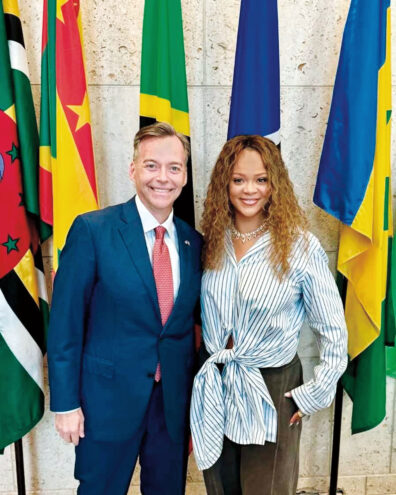
Early in his tenure as ambassador, Nyhus received a call that the Barbadian singer, songwriter, actress, and entrepreneur would be coming to his office the next day. Nyhus was a fan. After their half-hour meeting, he became a Rihanna “super-fan.” He says, “She could not have been more gracious. She gave me a hug at the end and said, ‘You’re fun. I hope this isn’t the last time I see you.’”
Nyhus was allowed extra luggage— “I think eight suitcases in all”—to his appointment. One was filled with Cougar Gold.
“Cheese is a rarity in the Caribbean. It’s imported and very expensive. They don’t have a lot of cows,” he explains. “Cougar Gold was a huge hit. I would occasionally give a can to an important guest. Mostly, I would serve it at my official residence and let guests know where it came from.”
He also brought a case of wine made by students in the WSU enology and viticulture program and, Nyhus says, “I served it to the president of Barbados.”