
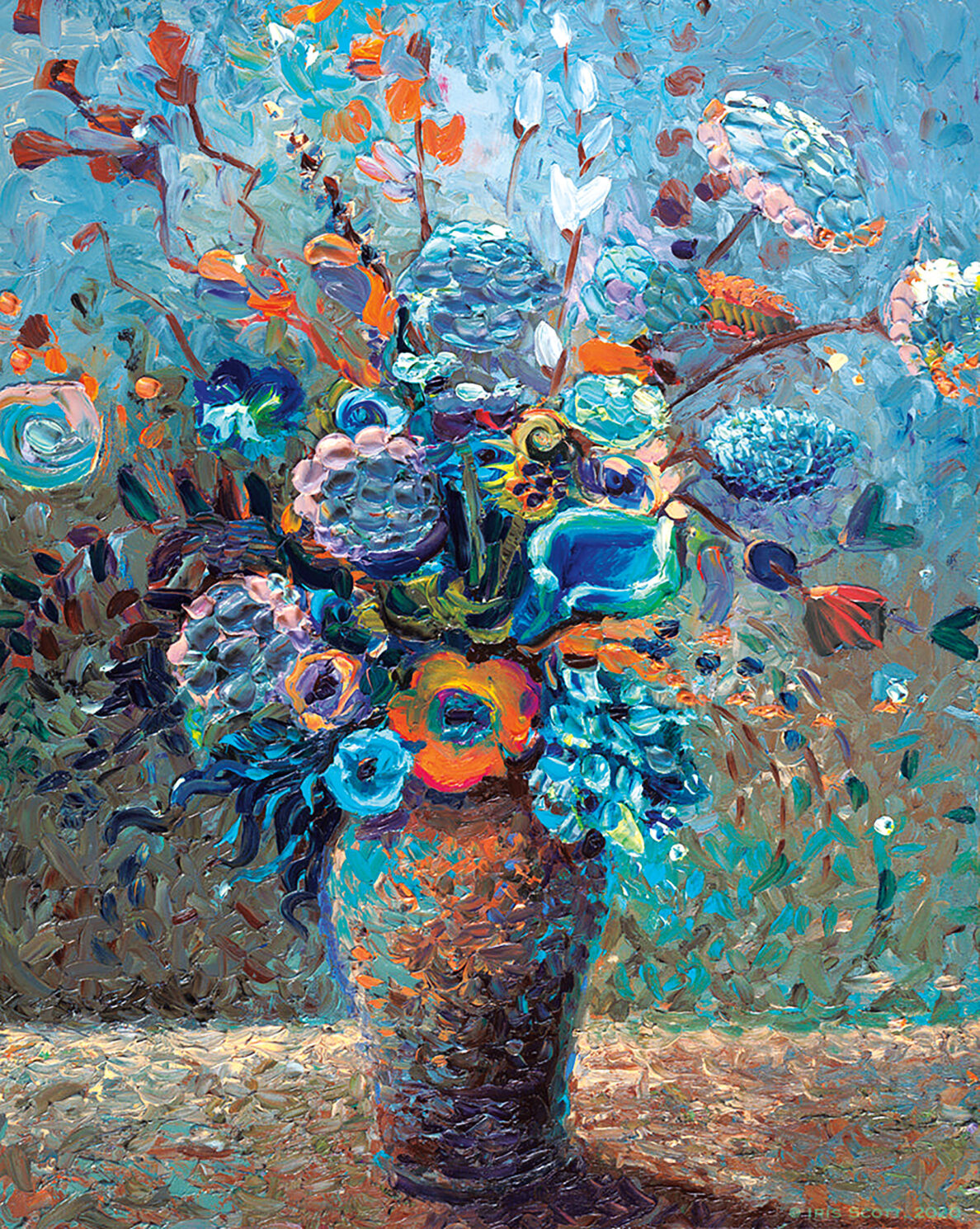
Iris Scott has been called “the world’s first professional finger-painter.” Her colorful works are big and bold and are indeed created with oil paints, canvas, and her fingertips. They’re also in big demand.
Her story has been told many times in national media and art publications. But what a lot of people don’t know is that her path was partly influenced by her counselor at Washington State University.

The Maple Valley native had planned to get a teaching degree at WSU and work on her art on the side. “You grow up hearing you can’t make a living from art,” says Scott (’06 Fine Arts). Instead, her counselor advised her to go all in on art and get a master’s degree in teaching as a fallback.
Her finger-painting technique was born of laziness: She didn’t want to spend time washing paintbrushes. But it found an appreciative audience via social media, which she says has been critical to her success.
“I was right on the front wave of content creation. I had something to share, and it was such free advertising. Not like it is now,” she adds.
Also important has been creating works that people want to buy—paintings that “hit them like a force.” Scott’s large-scale canvases might feature a dog shaking off water, or a tiger in a forest. There are sea creatures and mystical figures, landscapes and florals.
The biggest canvases sell for upward of $50,000 each, a level of achievement that helped Scott relocate in 2019 from her New York City studio to a 500-acre ranch in northern New Mexico.
The landscape there reminds her a little bit of the Palouse.
“WSU is yellow and blue, and kind of golden and expansive,” she says. “I resonated with that landscape.”
And with life at WSU.
Driving through the Palouse with her best friend, listening to music. Going to football games. Taking classes in subjects she never knew she was interested in, such as entomology.
“Just the freedom of coming into your young adulthood,” she says. “I was on cloud nine. I was just so in love with my college experience.”
After WSU, she moved to Taiwan expecting to teach English. She ended up turning to art full-time, and it’s there she began using her signature finger-painting technique.
Scott embraces that period because it taught her valuable lessons about surviving as an artist. She was selling paintings for $50, but that was a lot of money relative to her living expenses. That’s why, asked what advice she’d give to other artists wanting to build a career, she starts with controlling spending.
“It’s such a big deal that you don’t spend a lot of money,” she says. “I was very happy to be in an apartment with no hot water and living out of a backpack. I painted for eight hours a day and, if I made more money than I spent that day, I felt like a rich lady.”
More advice: Know your audience, because there is a market for art. But if your art isn’t selling, your prices are too high, she says.
Scott has moved beyond solely painting with her fingers. In recent years, she’s been incorporating brushstrokes and is now experimenting with a technique she calls cell blasting, using an air compressor. When she started finger-painting, it was partly to become very good at one thing. Now, “a decade and a half later, a thousand finger-paintings later, I was like, ‘Yeah, I have thoroughly explored that,’” Scott says. “The next decade will certainly be more about range than limitation.”