
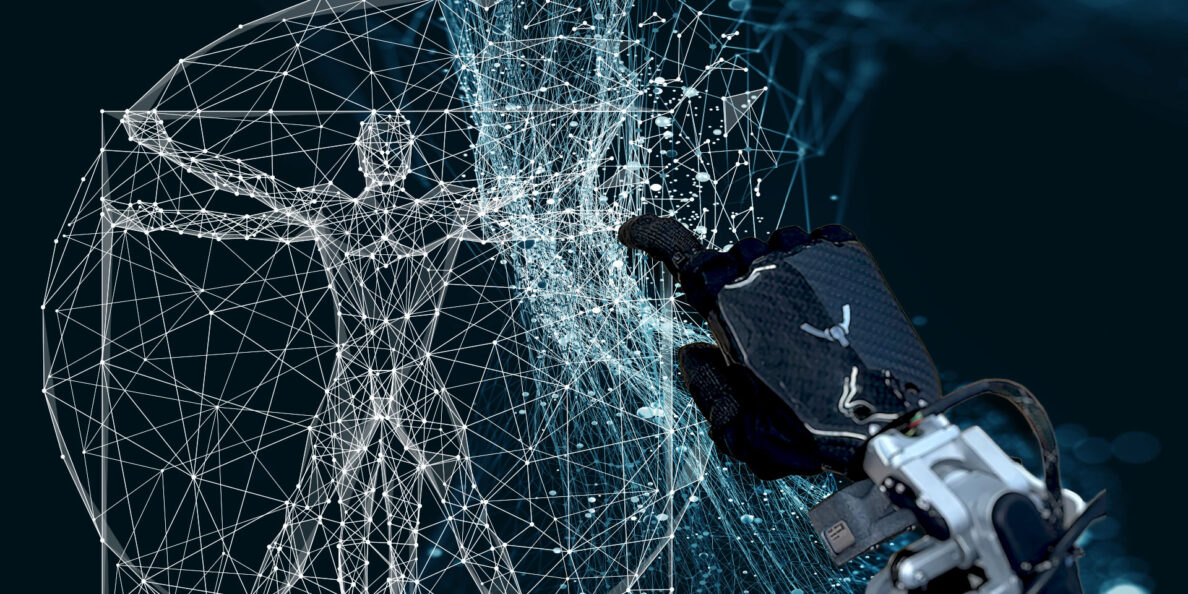
People working with robots require a safe environment,
where humans can trust their mechanical companions.
AI helps build that reliability.
Robots are nothing new in factories, warehouses, and even homes. They could be a giant arm welding pieces on a car, a small food delivery bot rolling around college campuses, or a robo-vacuum getting stuck under a chair.
Most early automatons, going back to the first industrial robot in a 1961 General Motors plant, were programmed to perform basic, specific tasks. Robots eventually gained sensors and better programming, but they often weren’t very sophisticated in responding to changes around them. The real world is messy and complicated.
Artificial intelligence, especially predictive large language models like Gemini or ChatGPT, is changing that dynamic by shifting how robots learn and ushering in an era when robots will adapt quickly to new situations.
Carolina Parada (’04, ’06 MS Elec. Eng.) works on the cutting edge of the field as senior director and head of robotics at Google DeepMind, where researchers have integrated Gemini’s models into robots and the physical world.
“We have believed from the beginning that AI is the way to transform robotics so that we can build robots that are truly intelligent, so that they can interact with you, (so) that they can reason about their environment, and they can take action in a way that feels very general,” Parada said in a 2025 Google DeepMind podcast.

(Courtesy Google DeepMind)
However, robots now require even more safety and reliability, especially ones that operate alongside people. Collaborative robots that work with humans, called “cobots,” have been a focus of industry and Washington State University researchers for many years. Advances in AI, which enable faster and more effective learning in the physical world, could also increase safety and resilience.
That’s crucial for the next robotic evolution. Humans effectively sharing space with robots—whether it’s a self-driving car or an automated factory machine—depends heavily on breaching a trust gap. The challenge for robots, on the other hand, is human unpredictability.
“For our work here, it’s mainly technical trust,” says Mehdi Hosseinzadeh, assistant professor of mechanical engineering at WSU. “We should really make sure that the robots are reliable. Their operation and their performance should be reliable enough that I can guarantee nothing will happen to your kid with a robot.”
Building trust in Cobots
Hosseinzadeh, an expert in control systems, joined WSU in 2022 and now leads the Safe and Intelligent Autonomous Systems Laboratory (SIAS). One area of research is training robots to manage unexpected human behavior.
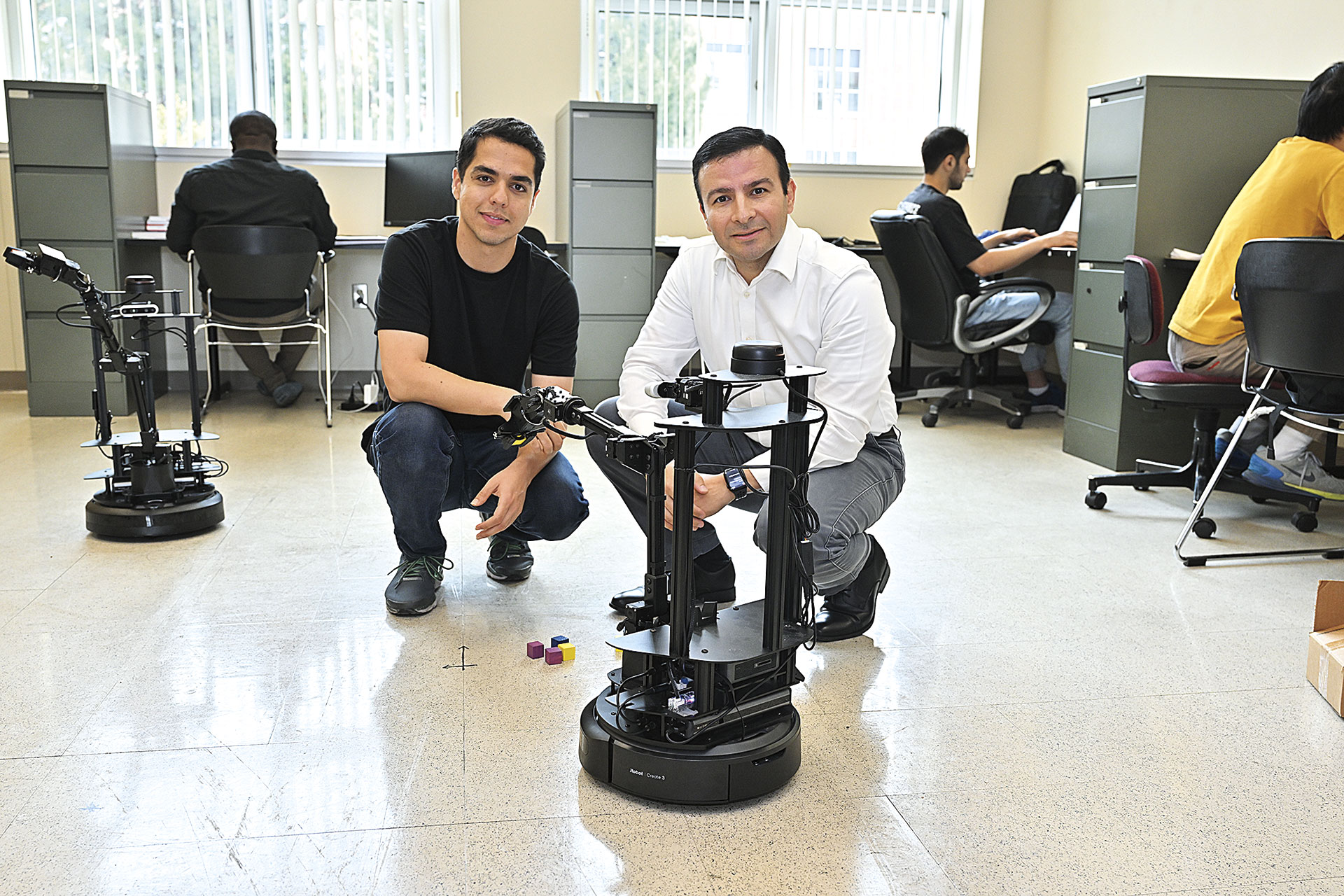
Humans excel in unstructured environments, Hosseinzadeh says, so robots should mimic that intelligence to succeed as cobots.
As humans, “we can easily understand uncertainty. Imagine I put you in an environment that you don’t know anything about. Just by looking, you will understand everything. Is this place safe or not? Is there an obstacle? With maybe less than a couple of seconds, you can really understand and you adjust your behavior,” Hosseinzadeh says.
He explains that if someone uses classic methods to train robots, with multiple sensors and mathematical formulations, it takes time when you might need a fast decision. That’s unacceptable with, for example, autonomous cars that are essentially robots on wheels.
A solution is to train robots to react safely using AI. Neural networks similar to a human brain—like LLMs—can react much faster than calculating math formulas every time. When a self-driving car encounters a kid playing in the street, a split-second decision can mean the difference between tragedy and relief.
One method to prevent problems, Hosseinzadeh says, is for robots to understand and even predict human behavior. Are people distracted with their cell phones, angry, or unaware of their surroundings? “Robots should be able to see a human and just get some cues from the human face,” he says.
Hosseinzadeh notes it’s impossible to add all scenarios for an AI-driven robot. Instead, SIAS researchers can group scenarios, which assist in training robots when they face similar situations.
Returning to the example of vehicles, he emphasizes the need for demonstration outside the lab.
“When people see autonomous vehicles, they might think, ‘Is this autonomous vehicle going to hallucinate something and crash?’ You should be able to guarantee it is not going to happen,” Hosseinzadeh says.
Out of the lab, into the field
Far outside a lab, WSU robots labor in apple orchards, using AI to improve their picking.
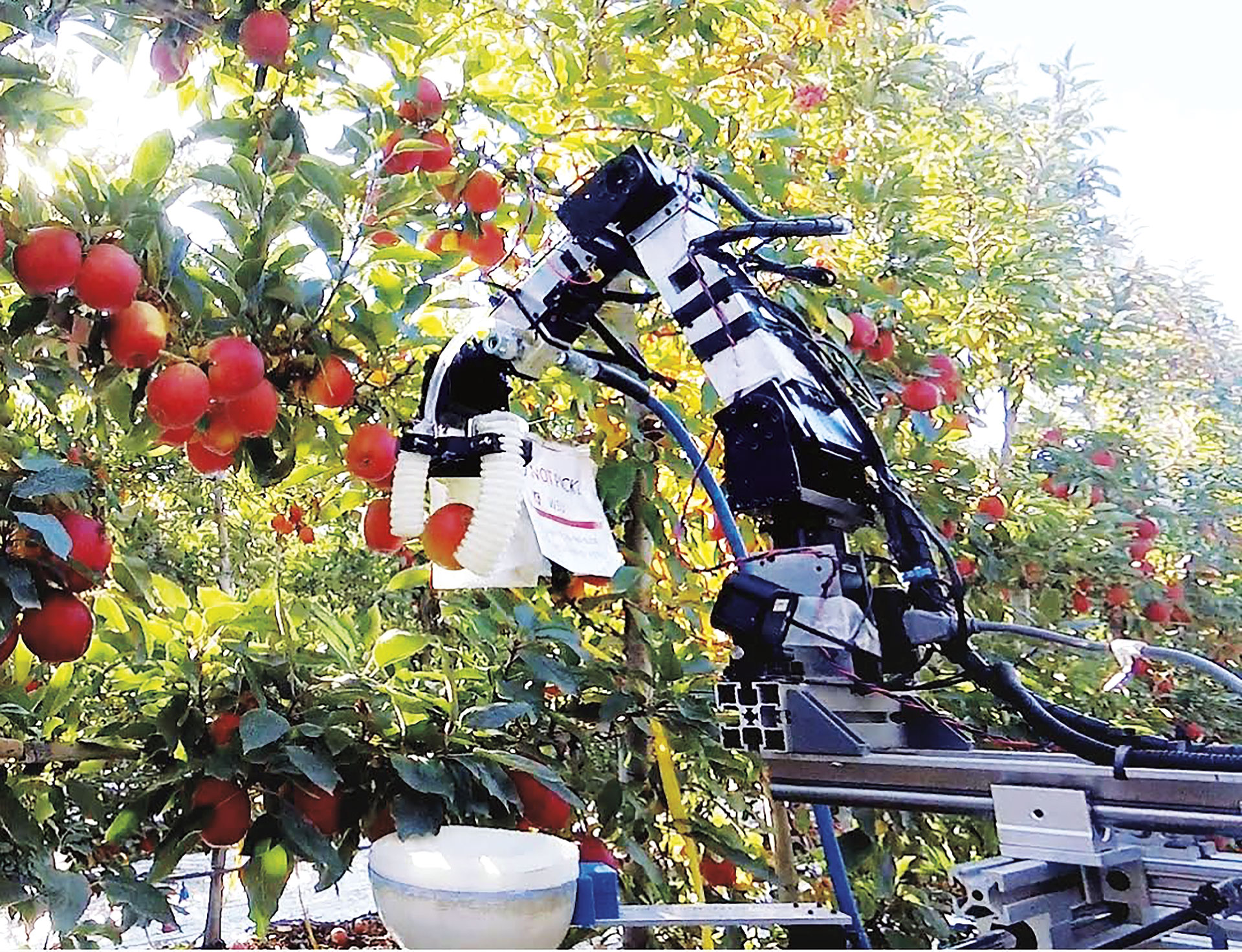
(Photo courtesy School of Mechanical and Materials Engineering)
Ming Luo, Flaherty Assistant Professor in the School of Mechanical and Materials Engineering, says those robots can harvest apples efficiently and safely in modern high-density orchards, but they need to navigate complexity in real-world trees.
Luo and his team overcome the limitations of traditional programming with AI-powered computer vision to identify fruit clusters. They pair that with human-guided machine learning to train the robots in complex maneuvers.
He emphasizes that robots can be affordable, practical tools meant to complement human workers rather than replace them. “There’s a real labor problem in agriculture,” he says, noting that, without robotic assistance, “apples are going to rot, and they’re not going to get picked.”

Luo has also studied psychological aspects of human-robot interaction. His team’s unusual robots—made with soft, fabric-based designs to protect fruit and human coworkers—increase trust and physical safety. He says standards for robot behavior, such as safe distances, can also help with technical trust.
Robots keep learning
Parada says she was partly inspired by Rosie the Robot from The Jetsons sci-fi cartoon from the 1960s. Rosie was fast, efficient, and kept the family safe in their far-future household. Such a robot might take a while, but it’s getting closer.
Parada’s team uses data-driven robot learning through Gemini Robotics, the latest advanced model. It brings LLM understanding, both visual and verbal, to the physical world. And it’s interactive, so robots can talk to people and translate discussions to physical action.
“We are now at a point where we are confident that if you can teach a robot, if you can operate a robot in a very complex task, it can learn it,” Parada said in the podcast.
There’s still much for robots to learn, though. The messy world is constantly changing. Humans do unexpected things all the time, which creates problems for cobots.
Still, increasingly sophisticated AI models are fueling a revolution in robotics and the ability of robots to adapt. Questions remain: What is acceptable risk and how can the trust gap be bridged?
“AI-driven robots are going to happen. But building trust is challenging,” Hosseinzadeh says. “What I can do in the engineering department is I can do my best to make sure that everything is reliable.”