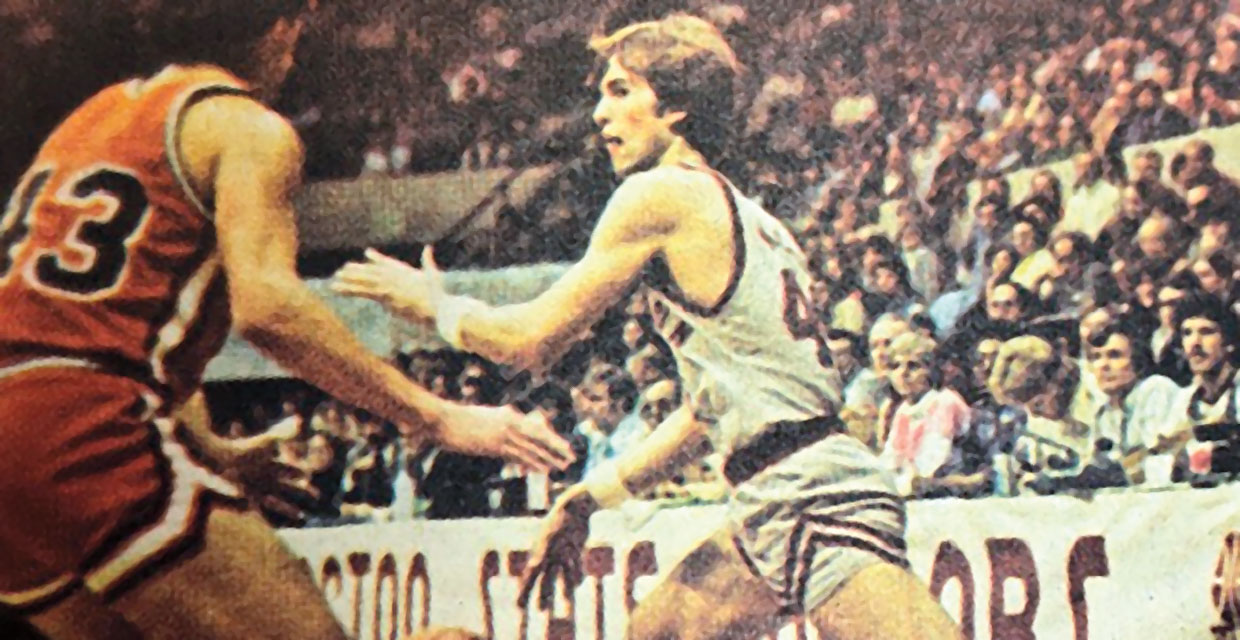

Many people could claim the title of Mr. Basketball in Spokane, Washington.
John Stockton is surely the greatest player the city has ever produced, but no one has a more complete basketball résumé than Terry Kelly.
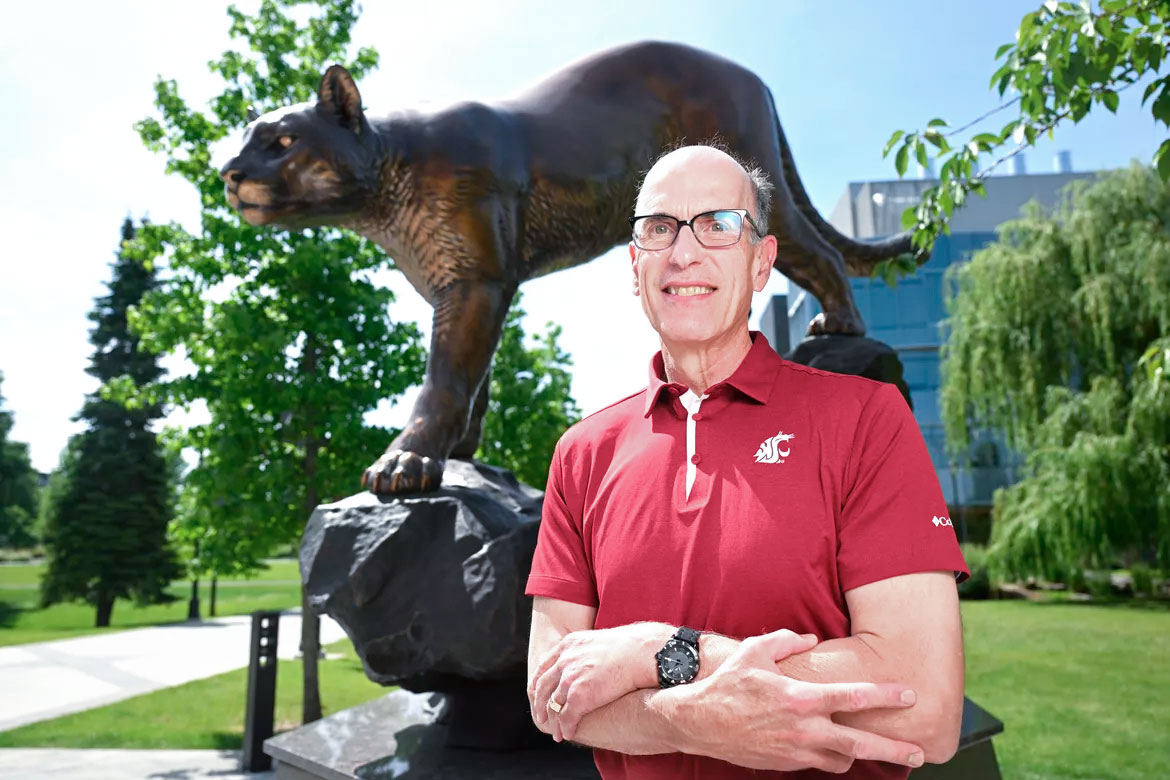
(Photo Jesse Tinsley/Spokesman-Review)
Kelly (’81 Accounting) was a superb high school player at Gonzaga Prep, starred at nearby Washington State University, and later was a founder of Hoopfest, which claims to be the largest 3-on-3 outdoor basketball tournament in the world.
Kelly is a member of the Inland Northwest sports hall of fame and remains general counsel for the WSU Foundation.
Basketball is in the blood of the 68-year-old Spokane resident, and always has been.
The 6-foot-1 guard led the state in scoring at 26 points per game during his senior year at Gonzaga Prep. The all-state player was recruited heavily by numerous college programs. But his goal was to play at WSU for legendary coach George Raveling.
“Everybody loved him,” says Kelly, who had attended Cougar Cage Camps as a youth and followed WSU sports teams closely.
“The games were fascinating to me,” he says from his fourth-floor office on WSU’s Spokane campus. “You could feel the energy.”
When the time came to pick a college, Kelly says it wasn’t a hard choice. He wanted to play in what was then the Pac-8 Conference and face teams like the legendary UCLA Bruins, who were just past the John Wooden era but still a formidable force.
“I was a small-town guy from Spokane. But I was playing against UCLA. There was no more big time than that,” he says.
“I felt like I could play there,” Kelly says, on why he spurned the University of Washington, Gonzaga, and other programs. He also declined an offer from Michigan State, which won a national title under Jud Heathcote while Kelly was in college.
“I would have been on a national championship team,” he muses.
But playing for Raveling, who died last year, was magical.
“He was not like anyone I had been around,” Kelly says. “His passion and commitment; he was all in. He was going to take you to the promised land. Everybody knew that he was special. You were proud to be part of the program.”
In a 2024 interview with the Spokesman-Review, Raveling recalled how Kelly was instrumental in luring college basketball recruiters to Spokane.
“Terry opened things up in Spokane,” Raveling said. “Terry was the validation that, yes, there are kids in Spokane who can play in the big time.
“Terry was the essence of the student-athlete. I’ve coached a lot of athletes, but I’ve only coached one or two who embodied all the characteristics of a student-athlete, which encompasses the classroom, the community, the games, their behavior. He might be my favorite student-athlete ever.”
Washington State never finished with a losing record while Kelly was on the team.
It all came together in the 1980 season, when the Cougars managed to beat every other team in the conference, breaking a 27-game losing streak to UCLA in the process. Kelly was captain of the 1980 team, the first WSU squad to make it to the NCAA Tournament in 39 years.
With Donald Collins as the 1980 conference Player of the Year, Raveling’s Cougars earned their first national ranking since 1950 and went 22–6 during the regular season.
The Cougars were rewarded with a No. 5 NCAA seed and faced 10th-seeded Penn. They held a 10-point lead in the second half, but Collins fouled out late and the Quakers rallied for the upset.
Kelly finished his college career with an average of 10.6 points per game over 101 appearances.
When not on the court, Kelly studied business administration with an emphasis on accounting. “My professors told me to take accounting. They convinced me accounting was a better major than marketing.”
After graduation, he attended the New York University School of Law and then landed a job at a prestigious Spokane firm. He specialized in finance and taxation and was in private practice for 36 years.
During that time he started representing the WSU Foundation.
“I developed a niche in corporate governance for nonprofits,” Kelly says.
“Three years ago I had an opportunity to be general counsel full-time for the WSU Foundation,” he says. “I feel like I’m back!”
The foundation manages about $800 million in an endowment fund and brings in more than $150 million a year in donations and grants, Kelly says.
The income is especially important because the government continues to scale back its support for higher education, he says, while “our private support only gets higher.”
Kelly has no plans to leave the foundation job. “I’m committed to the vision of WSU and want to be a part of that.”
Kelly has at least one other basketball claim to fame. He was a cofounder of Spokane’s annual Hoopfest, which brings thousands of players to Spokane for a weekend of streetball every summer.
At first he was skeptical that a city the modest size of Spokane could support an outdoor tournament that has grown to attract some 6,000 teams per year.
“I didn’t think there was that much interest in Spokane for basketball,” he says, and doubted the event could rival the city’s annual Bloomsday road race, which has drawn more than 50,000 runners per year at times.
But he agreed to become a member of the founding board and served on the panel for 26 years.
“It’s been an incredible ride,” he says of Hoopfest. “It’s turned into a massive tournament … a signature event for the community.”
Kelly wasn’t just a founder of Hoopfest. He played in numerous tournaments, winning his bracket several times.
Kelly has remained close to changes in the college game. He became friendly with coaches Dick and Tony Bennett when they rebuilt the WSU program earlier this century. The Bennetts emphasized defense and Kelly said it was a pleasure to watch their teams dismantle more physically gifted opponents.
“They made (other teams) look silly,” Kelly says. “I loved (Derrick) Low, (Robbie) Cowgill, and (Kyle) Weaver and those guys. It was a clinic.”
He is unhappy with the rampant changes in college sports that have resulted in many players jumping teams after nearly every season, unlike the kind of commitment when he played.
“I started 80 straight games,” Kelly says. “I had a strong connection with the fans. Palouse fans are incredible.”