
Yong Wang likes to create a good reaction.
Wang (’92 MS, ’93 PhD Chem. Eng.), a Regents Professor in the Gene and Linda Voiland School of Chemical Engineering and Bioengineering at Washington State University, researches catalysis, a chemical substance that enables reactants to come together and quickly form a product without being consumed itself.
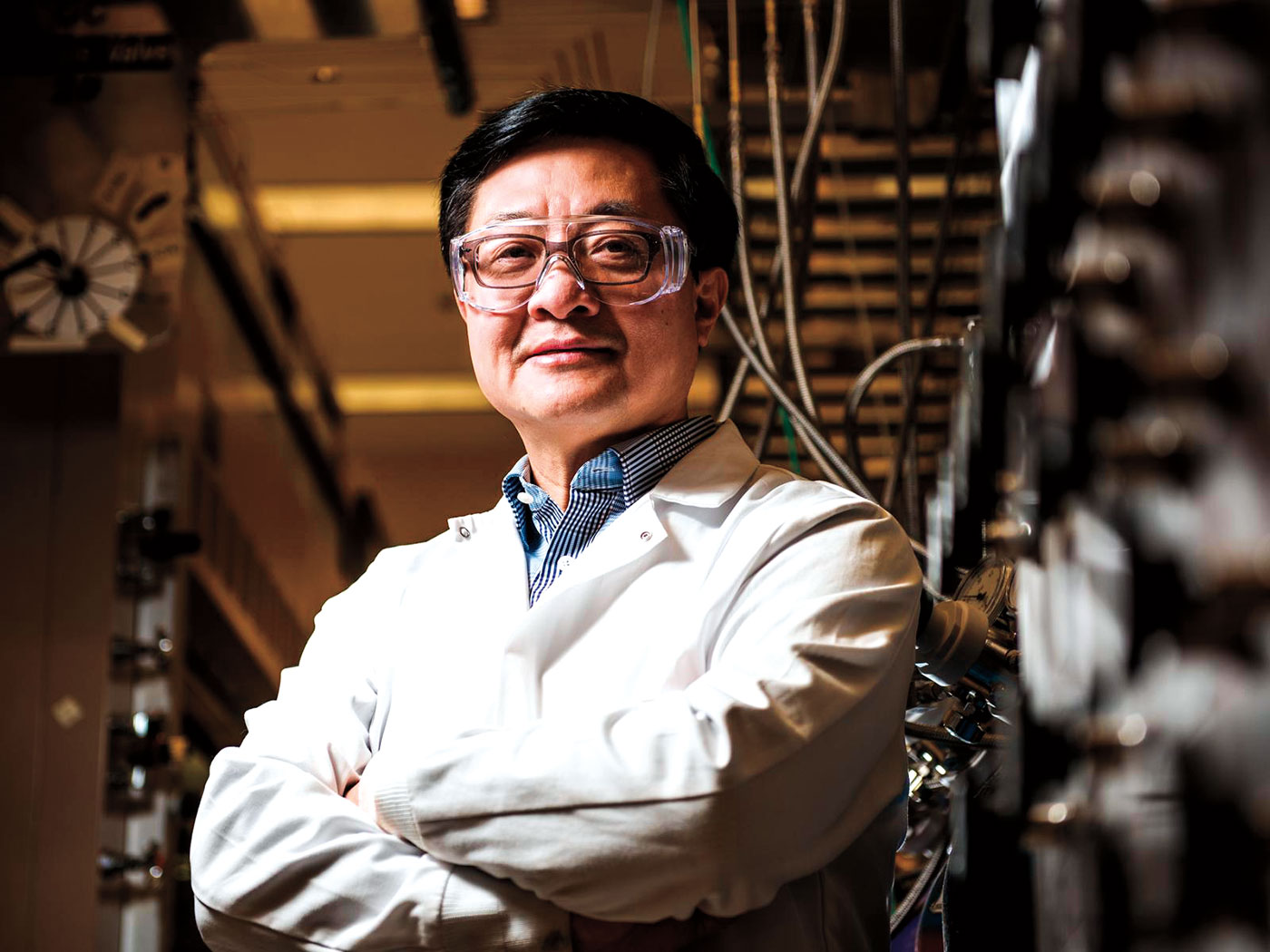
“If you don’t control catalysts properly, reactions can get out of control if you don’t know what you’re doing,” Wang says. “I like to see and control the radical change. It’s quite exciting and very dynamic.”
In the world of chemical engineering, Wang might be a catalyst himself, transforming those around him and helping to raise the reputation worldwide for WSU’s chemical engineering program. This year, he was elected as a member of the National Academy of Engineering (NAE), the most prestigious honor in engineering. Only about 2,500 of approximately 2 million US engineers are elected by their peers to the academy.
Wang was recognized with the honor for his work in advancing catalyst discovery, design, and reaction engineering for energy and environmental applications. He holds a joint appointment with the US Department of Energy’s Pacific Northwest National Laboratory (PNNL), where he is acting director of the Institute for Integrated Catalysis.
“I never anticipated to be where I am,” Wang says. “It’s really because of the great education I received at WSU and the wonderful opportunities for me to work with a fantastic group of people and colleagues. I think they got me here—not myself.”
Originally from Kunming, a city of about five million people in Southwest China known for its year-round mild temperatures, Wang arrived in Pullman in January 1990 to snow and subzero temperatures on campus.
“After I got back to my apartment, it took me at least two hours to have feeling in my face,” he says.
While Wang struggled with speaking and understanding English, cultural differences, and adapting to a new environment, he also enjoyed the challenges. He got needed support and encouragement from many around him, starting with his doctoral advisor, Bill Thomson. Wang didn’t know how rigorous the WSU program was, and he’s thankful to Thomson for inspiring him to work hard.
“There were many nights that first semester that I woke at midnight or 2 or 3 a.m. and thought, ‘Holy cow, I need to study!’ so I would jump out of bed and study,” he says. “I had no idea how much it would take, but I studied very hard and that was very beneficial, including later on in my career.”
After graduating, Wang worked as a postdoctoral researcher for chemical engineering professor Jim Petersen, and then PNNL.
The support from Petersen during those years proved pivotal. “A lot of people don’t recognize how special this place is to be in a small college town,” Wang says. “Especially when I first came over here, everyone was so kind and friendly. They provided a welcoming environment.”
Industry leaders at that time were arguing that schools needed to focus on the basics in chemical processing. Petersen and colleagues learned that PNNL was focusing on chemical catalysis, and they thought WSU could join efforts.
“Chemical catalysis is foundational to the development of technologies that reduce energy use and enable a clean environment,” Petersen says. “It is an area that is foundational to chemical transformation, yet most chemical engineering departments have only one or two faculty members working in it.”
Support from Gene (’69 Chem. Eng.) and Linda Voiland allowed Petersen to hire Wang in 2009 as the first Voiland Distinguished Professor and first joint appointee with a university in PNNL history.
“Jim Petersen was the first to pose the idea of getting world class engineering professors who could basically put the college on the map,” said Linda Voiland. “We had numerous conversations around that, and it just fell into place. Jim had a lot of good ideas about how to get it started and make it work.”
Gene Voiland says the education he received at WSU and professors like George Austin made a fundamental difference in his life and gave him the opportunity to excel.
“In any endeavor, you have to have top talent—not just in knowing how to do things but also in having the drive and energy to make them successful,” he says.
Wang is a world leader in his field of research, Voiland says, “but he’s also a real person with a really positive set of values and humility.”
Soon, the program brought in new faculty members to grow the research area. They were also able to move the program to Wegner Hall, which provided more lab space for researchers.
“Without Gene and Linda’s investment, this never would have happened. They were instrumental,” Petersen says. “With five or six faculty, we had one of the largest catalysis groups in a chemical engineering program in the nation.”
Initially, the program focused on catalysis for biofuels, but the research has grown to include work on automotive catalytic converters, electrochemical catalysis, computational catalysis, and material processing for better catalysis. Several faculty members have joint appointments with PNNL and can leverage that connection.
Catalysis is more than fun and excitement. It’s transformation, says Petersen, who is now emeritus professor in the Voiland School.
“It makes it so we can more efficiently use energy and reduce environmental impacts as we use energy,” he says. “And with all of these things, you can turn it into something that has a big and very real impact.”
Wang has also supervised more than 20 doctoral students as they completed their degrees. While research is important, the program trains students and creates engineers who are practical and oriented toward problem-solving.
When he learned of his election to the NAE in February, Wang reflected on who and what had helped him get to this point in his career. He will be formally inducted to the group during the NAE annual meeting on October 5, 2025.
“It didn’t happen overnight—it was an entire journey,” he says. “I actually have a list of people, so I called these people individually to thank them all—from the Voilands to Jim Petersen and Bill Thomson to friends and family members. I feel so grateful.”