
The plan was simple: snowshoe, sled, and spend quality time together just before Christmas 2012. Jessica “Jessie” Owen had new snowshoes and a new puffy coat. “I was pumped about it,” she says. “I was ready to go and have some family time.”
The Owens were headed to Leavenworth for a fun weekend when a 125-foot snow- and ice-laden grand fir snapped, crushing the cab of the SUV in which they were traveling—and forever changing their lives. Parents Tim and Cheryl Owen died at the scene. Sister Jaime Owen Mayer and brother-in-law Steven Mayer, in the middle row of the Chevrolet Suburban, suffered broken bones and other internal injuries. Jessie (’07 Ed.), also in the middle row, was partially paralyzed in all four limbs.
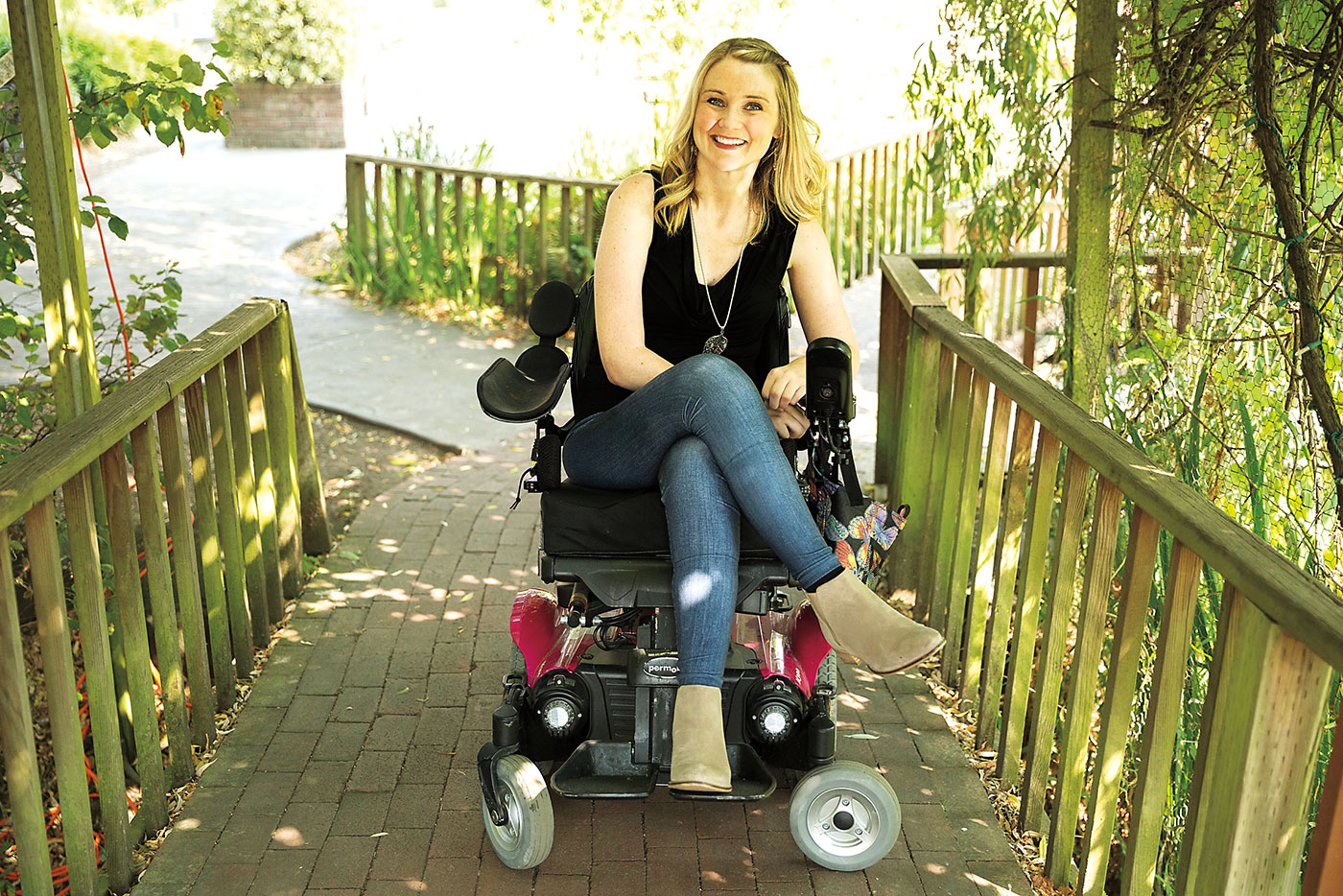 Courtesy Jessie Owen
In the nearly 13 years since the accident, Jessie has undergone numerous surgeries, stages of grief, rehabilitation, and counseling. She got married, had twins, found joy, and started advocating for other people living with spinal injuries.
“I want my boys to see me as nurturing and strong and as someone who shows up for them in every way that I can, as well as someone who takes care of herself and the world around her. I would be really proud of that, if that’s how they—and the world—saw me,” says Jessie, who has about 74,000 Instagram followers. On the platform, she describes herself as “stunnin’ but not runnin’.” Her handle: itswheelyjess.
Technically, she’s a C4 incomplete quadriplegic, “so I can move just about everything and feel just about everything but, like, not well. It’s all impaired,” Jessie explains in a recent video post on Instagram, where she shares things such as “wildly out-of-pocket things people have said to me because I’m in a wheelchair,” “five things about being a quadriplegic that people will never understand,” and “What is it really like being a quadriplegic mom?”
She posts videos of herself taking some of her first steps after the accident, along with snippets of life with her husband, Alan, and their boys, Maxwell and Miles, who turn 3 in June. She shares her reaction to a clip from when she appeared on Good Morning America to talk about the new technology helping her regain hand mobility.
Jessie participated in the Up-LIFT study, a clinical trial centered round ARC-EX Therapy System, an external spinal stimulator from the Netherlands-based Onward Medical. The non-invasive device, which works via electrodes placed above and below the injury site, received clearance from the US Food and Drug Administration in December 2024. It’s designed for use during occupational therapy sessions, typically lasting about an hour, three to four times a week.
“The study gave me tangible improvements in my hand function—small, but meaningful,” Jessie says. “I don’t want to oversell it like I suddenly woke up playing the piano, but I can feel subtle differences in how I interact with the world. For example, my grip is steadier when I pick up my kids’ snack cups, and I can manage finer movements, like peeling the sticker off a banana. It’s also made certain daily tasks less frustrating. Helping the twins get dressed, something I used to wrestle with, takes fewer tries. I don’t have to concentrate as much on keeping my grip steady while using a fork, which means fewer near-drops and more actually enjoying my meal. Even something as small as stabilizing my phone when I’m filming content—without my fingers awkwardly stiffening up—has made a difference in my work. … even incremental gains mean more independence. I don’t take that lightly. When you live in a body that doesn’t do what you want it to, any improvement—even 10 percent—is a big deal.”
Jessie, of Edmonds, is one of some 305,000 people living with spinal cord injuries in the United States. The country sees approximately 18,000 new cases each year, according to the National Spinal Cord Injury Statistical Center. Women make up less than a quarter of them.
Jessie doesn’t remember the accident. “It felt more like I had fallen asleep in the car and I was in a dream. It was fuzzy and very traumatic. I was sitting behind the front passenger seat. The window had blown out, and there was hair in my face. There was a woman, and she asked, ‘Do you know what happened? ’And I said, ‘I’m assuming we were in a car accident. ’ I asked my sister, ‘Is this real? ’ And my sister goes, ‘Yep, I think it’s real.’”
Brother Jeremy Owen, in the back row, escaped serious injury. After regaining consciousness, he broke out the back of the vehicle, believing everyone else had perished.
Jessie was taken by ambulance to the hospital in Wenatchee, then airlifted to Harborview Medical Center in Seattle. “I was intubated. I couldn’t breathe on my own. I had multiple broken bones. I couldn’t move.
“I was dealing with a lot of loss. I lost my autonomy. I lost my job. I lost my apartment. I lost my independence. I lost both my parents. And I felt like I had lost my hope. I was scared. I was scared to be alone.”
Family members and friends, many of them her sorority sisters from Gamma Phi Beta—of which she was president—made a schedule and stayed by her side “all the time. That’s the only thing that kind of allowed me to move forward. They constantly supported me,” says Jessie, who was 27, living in an apartment in Seattle’s Queen Anne neighborhood, and teaching sixth grade in Bothell at the time of the accident—just five years after her graduation from Washington State University.
“WSU is something special,” says Jessie, who turns 40 in July. “It’s the camaraderie and the community. You feel part of something bigger. And, truthfully, you feel like the underdog. But it’s always fun to be fighters and punch above your weight class.”
Shortly after the accident, doctors told her she would likely never walk again. For three years, she devoted her time to recovery, completing countless hours of rigorous physical therapy and getting to the point in which she could walk with forearm crutches for short periods. Mostly, she uses a motorized wheelchair to get around. Her sister walks with a cane. Her brother-in-law uses a forearm crutch.
“When all of a sudden your life is turned upside down you’ve got to find something to cling to, and that’s what I chose those first few years, and I felt good about it,” says Jessie, who turns 40 in July. Then I thought, ‘Hey, there’s more to my life and my story than just trying to recover and trying to walk again. Every single place in the world has disabled people, and we find a way.”
She started working with a life coach. She went back to teaching. She joined dating apps. In 2021, she got married. In 2022, she gave birth to twin boys. She took leadership classes through a Harvard University certificate program. She began sharing more about her life as a quadriplegic mom and wife on Instagram, TikTok, and Facebook.
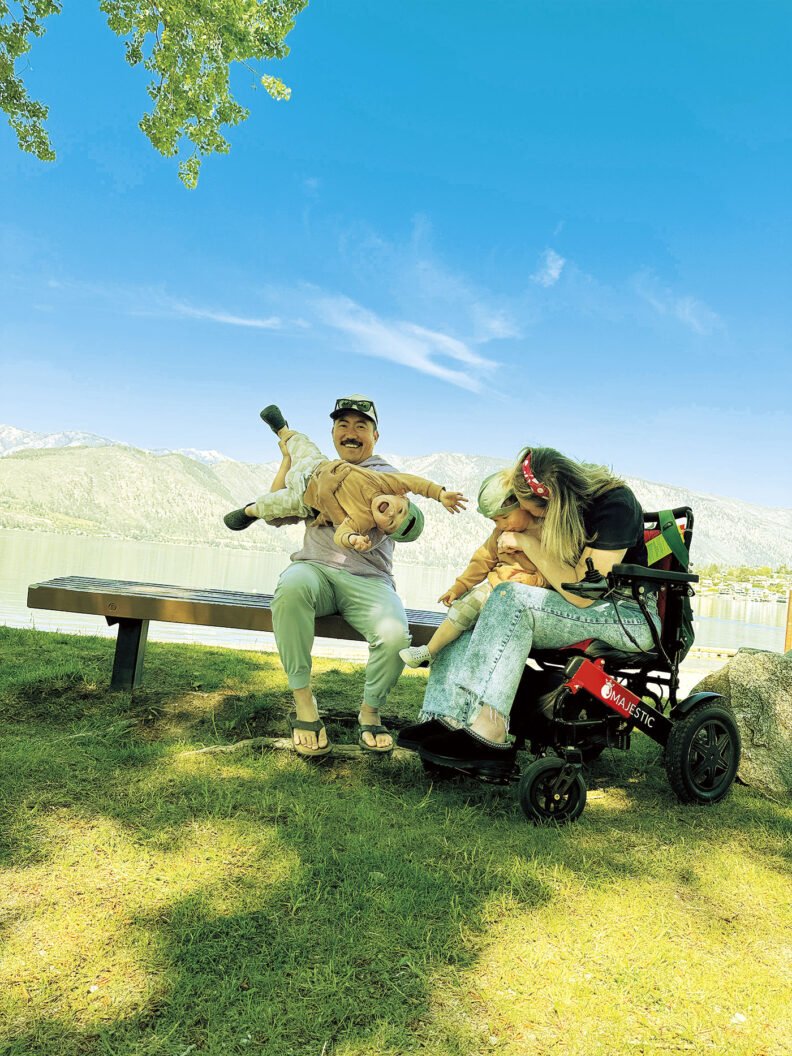 Jessie Owen with her two boys and husband (Courtesy Jessica Owen)
“I don’t have aspirations to be a big content creator,” she says. “I want to share my life with those who are interested and supportive. I believe in the village we create for ourselves, and social media is part of that village. I’m really happy to share all of my tips and tricks. I’ll continue to do it as long as I enjoy it.”
Part of her aim is to educate able-bodied people. “If you see a disabled person out in the wild, maybe you’ll be a little more cognizant of where you park or maybe you’ll develop some empathy.”
One of her biggest messages for others living with spinal cord injuries: “There is joy to be had for you. You can still find a way to be happy. I’m here to say that I pursued happiness relentlessly. I worked hard for it and I’m lucky. I have found and built this life that fills my cup all the way to the brim. I have everything that I want. I have enough.”
Social media aren’t always positive places. “There are people who say I’m selfish for having kids and that I’m a waste on the planet. Those are the people you block,” says Jessie, who now works part-time for Onward Medical, makes media appearances, and entertains speaking engagements.
She also serves as a member of the advisory board for the National Center for Disability and Pregnancy Research and as co-chair of the Diversity, Equity, Inclusion, and Accessibility Commission for the city of Edmonds. She has worked with the Christopher & Dana Reeve Foundation to create educational materials about different types of spinal cord injuries.
“I was not meant to live a small life,” she says. “I was meant to live a big life.”