
Decades after the Vanport flood,
a complex racial and
environmental legacy lingers.
On a Sunday afternoon, May 30, 1948, Oregon’s second-largest community vanished in a flood.
That morning, Portland’s housing authority had assured Vanport residents the rising Columbia River was unlikely to breach protective levees and, if the situation changed, families would get plenty of notice to evacuate.
But residents had just 35 minutes to flee after a railroad embankment failed. Evacuees streaming up the single road leading out of Vanport looked back to watch floodwaters slamming into apartment buildings, knocking them off their foundations.
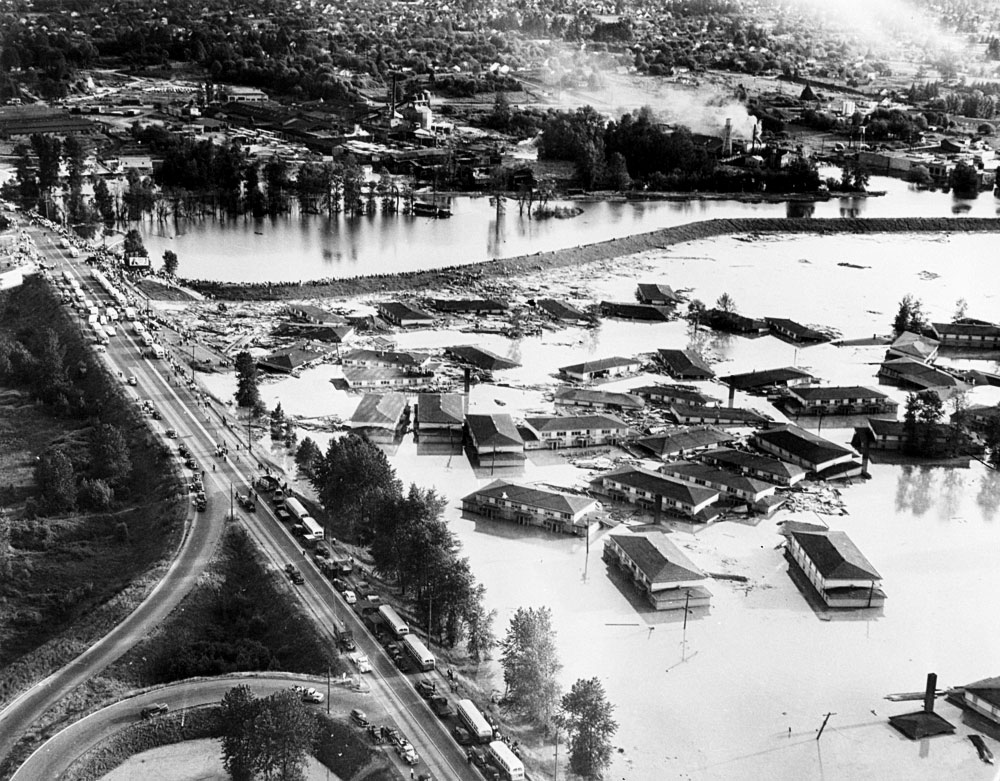
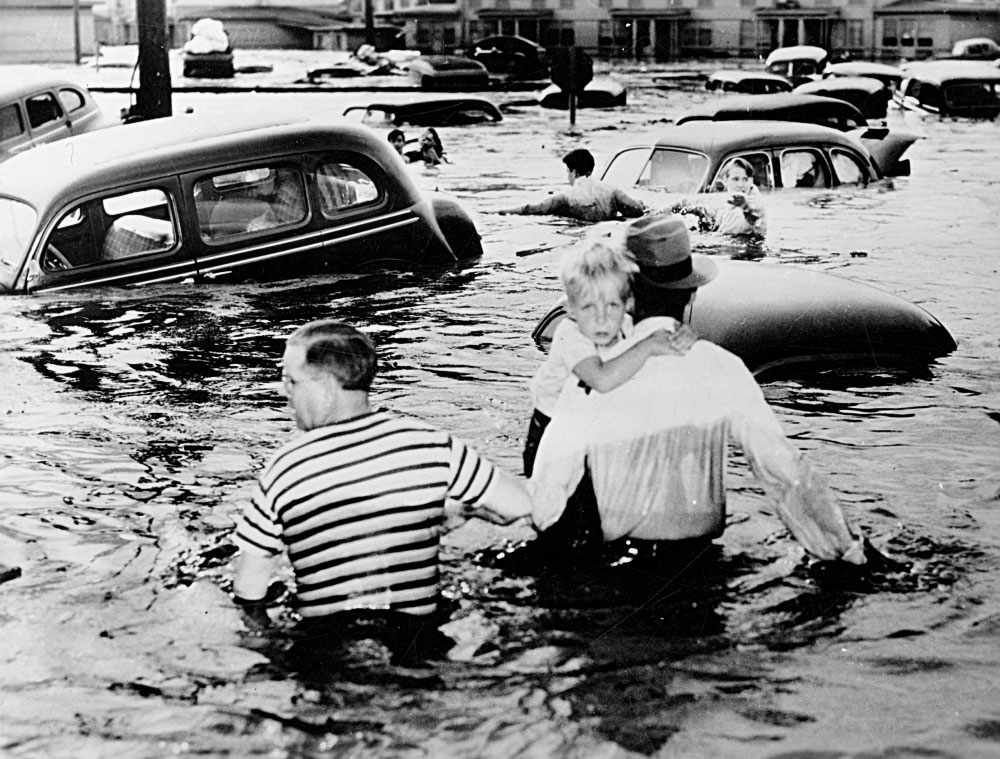
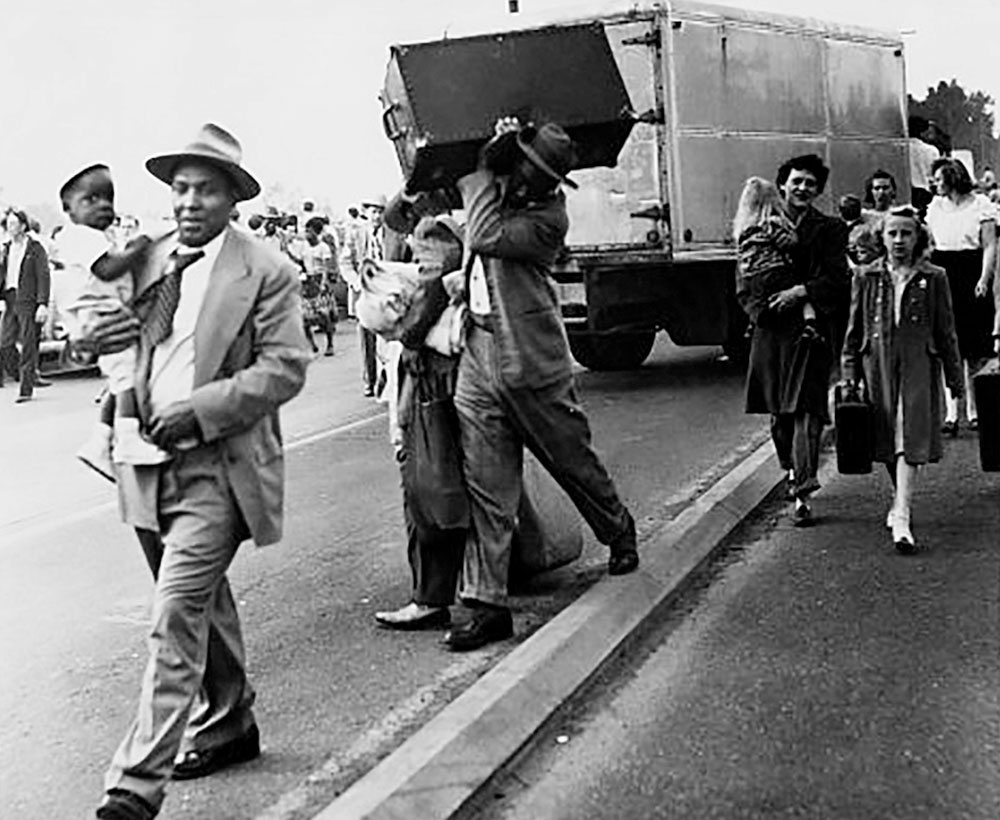
The nation’s largest wartime housing project—built by industrialist Henry J. Kaiser to house shipyard workers and their families during World War II and home to Oregon’s largest Black community—was gone.
Although Vanport’s story is unfamiliar to most Northwesterners, its complicated racial and environmental legacy still lives on in the region, says Jeffrey C. Sanders, a Washington State University history professor. His recent book about the postwar West, Razing Kids, includes a chapter on Vanport, which housed 40,000 people at its peak.
“Vanport is one of those pivotal moments in history,” Sanders says. “Not only the flood, but the decision to build a major housing development on a marshy floodplain, which is where historically marginalized people often live.”
After the flood, Vanport’s destruction became a rallying cry for dam building across the Columbia Basin. Besides flood control, Northwest politicians and business leaders saw a future for low-cost hydropower to run postwar industries and heat new residential developments with electric baseboards. But the dams’ costs and benefits were distributed unequally, Sanders says, with middle-class whites gaining the most.
Portland’s racist housing covenants led to Vanport’s hasty construction. During World War II, Kaiser advertised nationally for workers in his two North Portland shipyards and one in nearby Vancouver, even offering free train tickets. Women, rural laborers, and Black families from the South answered the call. Between the three shipyards, Kaiser employed more than 90,000 people.
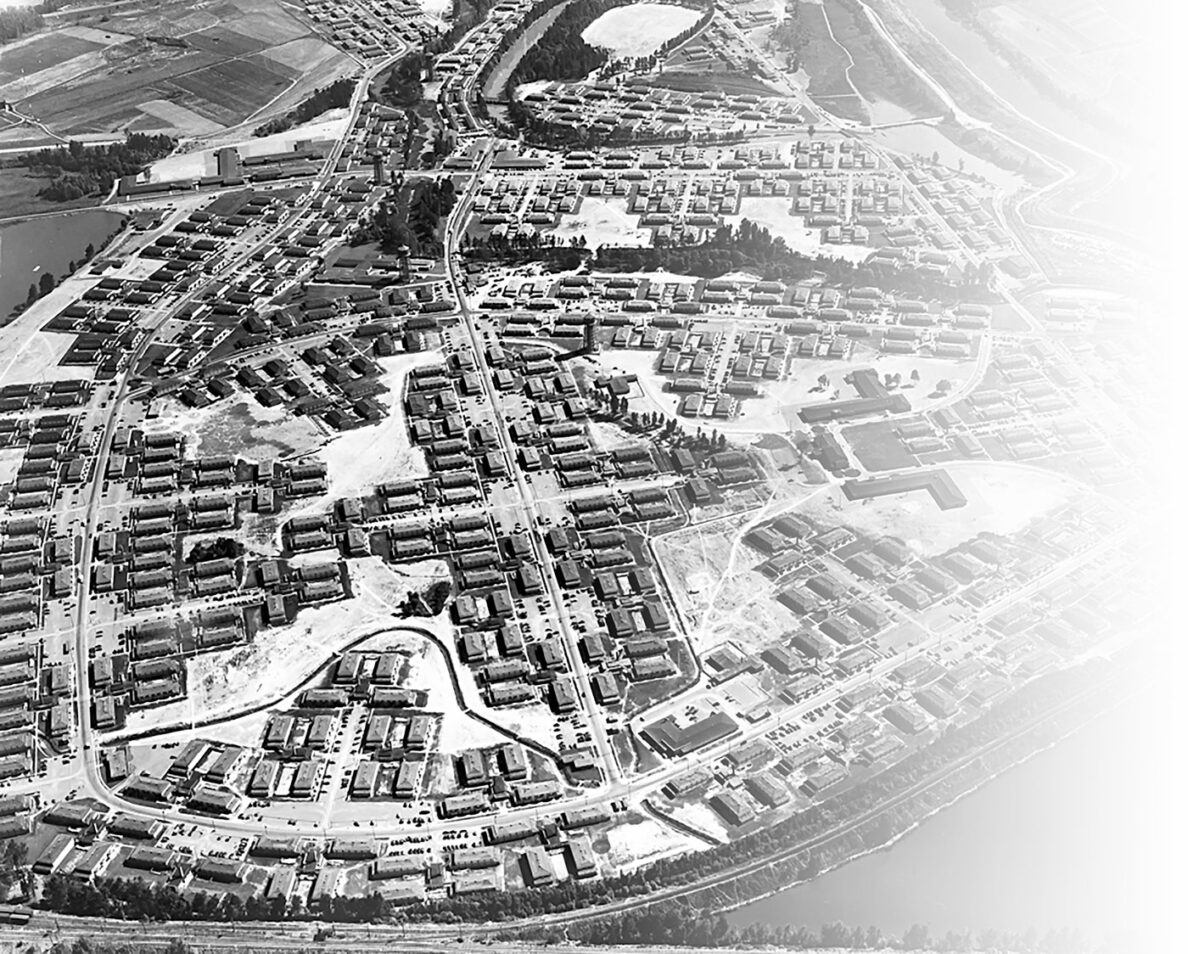
Portland struggled to house the influx of defense workers—particularly Black residents who were only allowed to live in the Albina neighborhood. Kaiser took matters into his own hands. His son, Edgar, worked with the US Maritime Commission to purchase 650 acres north of city limits. The low-lying acreage was between the Columbia River and the Columbia Slough.
Vanport, also known as “Kaiserville,” was built between late 1942 and 1943 with federal money and cheap construction materials. Families lived in thin-walled, single-bedroom apartments. Streets were muddy, and residents often complained about the traffic noise from shift workers coming and going in the 24-hour community.
But Vanport’s novel amenities also endeared it to many residents, Sanders says.
Kaiser built state-of-the-art childcare facilities to accommodate working mothers. Although housing was segregated, Vanport’s schools were racially integrated and employed some of Oregon’s first Black teachers. Kaiser employees received free health care through a plan that later became Kaiser Permanente insurance. And the local movie theater showed round-the-clock features.
Vanport was always intended as a temporary community, and many families left after the war ended. By 1948, the population had shrunk to 18,500. About one-third of Vanport’s remaining residents were Black families who still weren’t welcome in most Portland neighborhoods.
That spring, a deep snowpack lingered in the Columbia Basin until a rapid melt-off in May. Despite the Columbia River’s threatening flows, neither the Army Corps of Engineers nor Portland’s housing authority, which administered Vanport, called for residents to evacuate. Fifteen people died that Sunday afternoon, and had the floodwaters come at night, the fatalities likely would have been greater.
The Vanport flood story was quickly co-opted by dam-building proponents, Sanders says. “If you look at the language in the 1950 federal Flood Control Act, it just balloons into ‘We need to do this.’”
The Northwest economy benefited from the dams’ cheap, renewable power, which produced airplanes, aluminum, and other high-value goods. But expansion of the Columbia Basin’s federal hydroelectric system came at a staggering cost to Native Americans. The federal government acknowledged the dams’ role in the devasting loss of salmon runs and flooding of Native ancestral lands and sacred sites in a 73-page report released in June 2024.
Black families displaced by the flood, meanwhile, struggled to find permanent housing. Many ended up in the crowded Albina neighborhood. Today, the Vanport site is the home of West Delta Park, a golf course, and Portland International Raceway.
To Sanders, Kaiser’s role as a postwar subdivision developer is a final irony. The company used aspects of Vanport’s urban design as a template for residential developments in the Pacific Northwest and California.
“Who could afford these new homes in the suburbs? White servicemen were the ones who could get the loans,” Sanders says. “Through the 1950s, these developments had covenants that excluded people of color. It’s deeply problematic.”
Learn more
Views of Vanport (video and gallery)
Video: The Flooding of Vanport (Oregon Public Broadcasting)
Gallery: Vanport photographs (Oregon Historical Society Digital Collections)
The Vanport Flood (Essay by Michael McGregor at the Oregon History Project)
Vanport (Essay by Carl Abbott, Oregon Encyclopedia)