
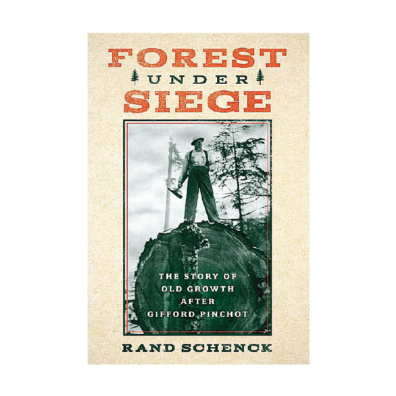
Rand Schenck
Basalt Books/WSU Press: 2024
A cabin nestled in old-growth groves of southern Washington state stirred up some questions for author Rand Schenck. Fulfilling his longtime dream, he bought an old rustic cabin in the Gifford Pinchot National Forest, where he could see volcanic peaks and giant, ancient trees alongside swaths of clear-cut forest.
How did this happen, that only 5 percent of old growth—trees from 300 to 500 years old—remain in the region? Schenck uses what happened to the 1.3 million acres of the Gifford Pinchot National Forest (GPNF) to represent the transformation of Pacific Northwest forests.
Schenck’s book examines the history of the US Forest Service in the GPNF through three phases: the first four decades of stewardship, 40 years of relentless production starting around 1946, and about 25 years of conservation and restoration. During the century of USFS management, extensive harvesting, timber wars, and conservation efforts all play a part in the story.
One of Schenck’s other purposes in the book is to take another, more clear-eyed look at Gifford Pinchot himself, a conservationist and the first USFS director. Pinchot and his legacy, Schenck notes, are misunderstood by both environmentalists and people in the forest industry. Those in the environmental and preservation movement see Pinchot as a mostly utilitarian leader, and one who saw forests only as a resource to exploit.
Meanwhile, Schenck writes, “the Forest Service continues to pay homage to its founder, while on the other hand acting in opposition to his vision of sustainable forestry and sustainable communities.”
Schenck sees Pinchot as a conservationist leader like John Muir. He writes how Pinchot was awed by the wild, huge forests of the West Coast, and wished to save them in perpetuity.
The book ends on a hopeful note. Schenck, an environmentalist and conservation advocate, sees opportunities to restore biodiversity in degraded forests through nurturing old growth and taking the long view toward forest management.
Purchase Forest Under Siege at WSU Press